You’re texting a friend about something ridiculous that just happened, and they suddenly reply, “SMDH.” If you’re wondering What SMDH Mean in Text, the abbreviation usually means “shaking my damn head.” People use it to show disbelief, frustration, disappointment, or amusement when something seems silly or hard to believe.
You’ll often see SMDH in text messages, social media comments, DMs, memes, gaming chats, and casual conversations. It’s closely related to SMH, but the word “damn” adds extra emphasis and emotion.
The exact feeling can change depending on the situation. A close friend might use SMDH playfully, while someone in a serious conversation could use it to express genuine annoyance or disappointment.
If you’ve come across this abbreviation and weren’t sure how to interpret it, you’re not alone. Below, you’ll learn what SMDH means, how people use it in different situations, what tone it can carry, and when it’s better to choose a different expression.
Quick Answer: What Does SMDH Mean?
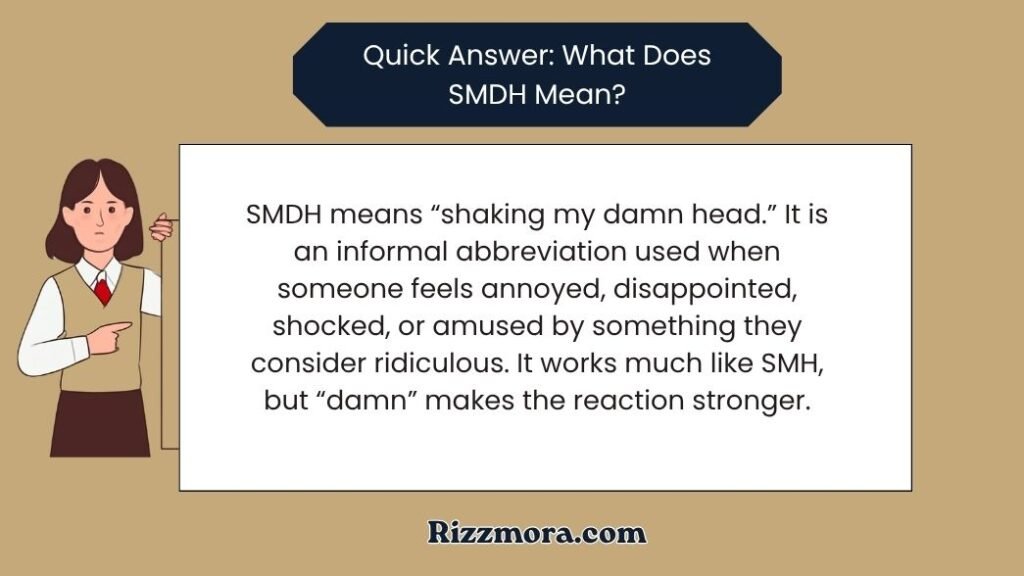
SMDH means “shaking my damn head.” It is an informal abbreviation used when someone feels annoyed, disappointed, shocked, or amused by something they consider ridiculous. It works much like SMH, but “damn” makes the reaction stronger.
A: He forgot his own birthday again.
B: SMDH.
A: She paid $40 for a sandwich.
B: SMDH.
Detailed Meaning Breakdown
Primary Meaning
The most common meaning of SMDH is “shaking my damn head.”
The phrase comes from the physical gesture of shaking your head when something is disappointing, ridiculous, frustrating, or difficult to believe. In texting, the abbreviation lets someone express that reaction without typing the whole sentence.
For example:
“He left his phone at home and drove back 30 minutes later. SMDH.”
The sender probably isn’t literally shaking their head. Instead, SMDH communicates a reaction similar to “I can’t believe this” or “What are you doing?”
It often carries a stronger emotional punch than SMH because of the added word “damn.”
Secondary Meanings
Although “shaking my damn head” is the standard interpretation, the emotional meaning can shift.
SMDH may communicate:
- Disbelief: “You actually did that? SMDH.”
- Frustration: “They changed the meeting time again. SMDH.”
- Disappointment: “He promised he’d help and never showed. SMDH.”
- Amusement: “You wore two different shoes to work? SMDH 😂”
- Mild disbelief: “You really forgot the password again? SMDH.”
Context matters more than the letters themselves.
A close friend may use SMDH playfully, while someone you barely know could make it sound more critical. I’ve noticed that short slang expressions often feel much stronger when there is no extra context around them.
Rare or Misinterpreted Meanings
SMDH does not normally have a completely different meaning in ordinary texting. The main interpretation remains “shaking my damn head.”
One common misunderstanding is assuming that every use is angry. That’s not necessarily true.
Someone might type:
“You put ketchup on that? SMDH 😂”
Here, the sender may be teasing rather than genuinely upset.
Another person might write:
“SMDH. I can’t believe they treated you like that.”
That use is more sympathetic and frustrated.
The safest approach is to look at the surrounding message, relationship, punctuation, and emojis before deciding how serious the expression is.
What SMDH Means in Different Contexts
In Texting and Messaging
In everyday texting, SMDH is usually a quick emotional reaction. Someone may send it after hearing surprising news, seeing a silly decision, or becoming frustrated with another person’s behavior.
For example:
“He spent his whole paycheck on sneakers.”
A response could be:
“SMDH, you warned him too.”
Here, the abbreviation communicates disbelief mixed with frustration.
Texting also makes SMDH useful because it saves time. Instead of writing “I am seriously shaking my head at this,” a person can simply type three or four letters.
The tone is usually casual. I wouldn’t expect to see SMDH in a formal letter, academic paper, or serious business email.
On Social Media Platforms
On social media, SMDH can appear in comments, captions, replies, DMs, and stories.
On Instagram, someone might comment:
“You really posted that old picture? SMDH.”
On TikTok, it can appear as a reaction to a strange video:
“SMDH, why would anyone do this?”
On Snapchat, the abbreviation may be sent privately as a quick reaction to a friend’s story.
Threads users may use it in a short reply to someone’s post, especially when reacting to an unpopular decision or surprising event.
The platform usually doesn’t change the basic definition. What changes is the tone and audience. A public comment can feel more critical than a private message between close friends.
In Dating and Relationships
SMDH can appear in romantic conversations, but its meaning depends heavily on the relationship.
For example:
“You said you weren’t hungry and then ate half my fries. SMDH.”
That could be playful teasing.
A more serious example might be:
“You canceled again without telling me. SMDH.”
Now the abbreviation communicates genuine disappointment.
Because dating conversations can already carry emotional tension, SMDH may sometimes sound harsher than intended. A partner who is upset may understand it as sarcasm or criticism.
If the subject is serious, writing out your actual feelings is often clearer than relying on slang.
In Professional Communication
SMDH is generally too informal for professional communication.
Using it with a close coworker in a private chat might be understood as casual humor, depending on workplace culture. However, using it in an email to a manager, customer, client, or unfamiliar colleague could make you appear disrespectful.
For example:
“The client changed the requirements again. SMDH.”
That may be understandable in a private conversation with a friend, but it isn’t appropriate for a client-facing email.
In professional settings, phrases such as “That’s frustrating” or “I’m surprised by this change” are clearer and safer.
Cultural or Regional Differences
SMDH is strongly associated with informal English-language internet and texting culture, especially American online slang.
You may see it among different age groups, but younger internet users are generally more familiar with abbreviations and casual digital expressions. Older users may understand it through context even if they don’t use it themselves.
The meaning usually stays the same across English-speaking online communities. What changes is how comfortable people are with the profanity contained in the full phrase.
That distinction matters. The word “damn” is mild profanity for many speakers, but not everyone considers it appropriate.
Where Is SMDH Used?
- Snapchat 👻
A friend might send “SMDH” after showing you a funny or questionable decision. - TikTok 🎵
Someone may comment “SMDH” when reacting to an unbelievable video. - Instagram DMs 📩
A friend could use it after you tell them about an annoying situation. - WhatsApp 💬
SMDH may appear in group chats when someone makes an obviously bad choice. - Gaming chats 🎮
Players might type it after a teammate makes a frustrating move.
Overall, SMDH is casual slang. It can sometimes be semi-casual among friends or coworkers who already communicate informally, but it is not a formal expression.
Also Read This: What Does KMO Mean in Text
Tone, Psychology & Why People Use It
Why People Use It & What It Signals Socially
SMDH gives people a fast way to communicate an emotional reaction.
Instead of explaining:
“I can’t believe someone would make that decision.”
A person can type:
“SMDH.”
The abbreviation works almost like a digital facial expression. It tells the reader that the sender has reacted strongly to what they just saw or heard.
It can also create a sense of shared humor. Friends sometimes use exaggerated reactions because the dramatic response makes an ordinary conversation more entertaining.
The word “damn” adds emphasis. That’s why SMDH often feels more expressive than simply saying SMH.
Emotional Layer Behind It
SMDH can have several emotional tones.
A friendly tone might sound like:
“You bought another hoodie? SMDH 😂”
The sender is probably teasing.
A neutral or mildly annoyed tone could be:
“They forgot to send the tickets again. SMDH.”
A cold tone might be:
“SMDH. Whatever.”
The last example can feel dismissive because there is little explanation around it.
Punctuation matters, too. “SMDH 😂” often feels lighter than “SMDH.” A laughing emoji can soften the reaction, while a period can make it feel more serious.
10 Real Conversation Examples (Explained)
1. Forgetting Something Important
Message: “I left my keys inside the car again.”
Reply: “SMDH.”
Meaning: The person is reacting to a repeated mistake.
Tone: Mildly frustrated but potentially playful.
2. A Friend Makes a Bad Purchase
Message: “I bought that expensive phone without checking the reviews.”
Reply: “SMDH 😂”
Meaning: The friend thinks the decision was questionable.
Tone: Teasing rather than hostile.
3. Someone Breaks a Promise
Message: “He said he’d show up and never came.”
Reply: “SMDH.”
Meaning: The sender is disappointed by the person’s behavior.
Tone: More serious and critical.
4. A Strange Food Choice
Message: “My brother puts ranch on literally everything.”
Reply: “SMDH.”
Meaning: The sender finds the habit ridiculous.
Tone: Lighthearted.
5. A Work Problem
Message: “The meeting was moved to 7 a.m. tomorrow.”
Reply: “SMDH, seriously?”
Meaning: The person is frustrated about the inconvenient schedule.
Tone: Annoyed and surprised.
6. A Dating Situation
Message: “She canceled our date five minutes before I left.”
Reply: “SMDH. That’s rough.”
Meaning: The sender disapproves of the situation and sympathizes.
Tone: Supportive with frustration.
7. A Gaming Mistake
Message: “I accidentally sold my best weapon.”
Reply: “SMDH 😭”
Meaning: The friend can’t believe the mistake.
Tone: Amused disbelief.
8. A Social Media Post
Message: “Someone posted their entire private argument publicly.”
Reply: “SMDH.”
Meaning: The person thinks sharing the argument was a poor decision.
Tone: Judgmental or disapproving.
9. A Repeated Mistake
Message: “He forgot his password for the third time today.”
Reply: “SMDH.”
Meaning: The repetition makes the situation ridiculous.
Tone: Exasperated but possibly humorous.
10. An Unexpected Result
Message: “They lost the game after leading by 20 points.”
Reply: “SMDH, I can’t believe it.”
Meaning: The sender is shocked by the unexpected outcome.
Tone: Strong disbelief and disappointment.
Where Misunderstandings Happen
Context Confusion
The biggest problem with SMDH is that the abbreviation doesn’t explain why someone is shaking their head.
A reader has to use the previous messages to understand the reaction.
If someone simply sends “SMDH,” you may not know whether they’re joking, annoyed, disappointed, or genuinely upset.
Generational Gap
Internet slang changes quickly. Someone familiar with texting abbreviations may immediately recognize SMDH, while another person may need to search for the meaning.
This can create confusion in conversations between people who use different communication styles.
The same abbreviation may also feel natural to one age group and overly casual to another.
Platform Differences
A comment on TikTok can feel more playful than the same three letters in a serious private conversation.
Public comments also lack the facial expressions and voice cues found in real-life conversations. As a result, readers may interpret a short reaction more seriously than the sender intended.
Similar Words, Symbols, or Abbreviations
| Term | Meaning | How It Differs from SMDH |
|---|---|---|
| SMH | Shaking my head | Similar reaction, but without “damn” |
| OMG | Oh my God | More focused on surprise or shock |
| WTH | What the heck/hell | Often expresses confusion or disbelief |
| WTF | What the f*** | Usually stronger and more explicit |
| LOL | Laughing out loud | Signals amusement rather than disappointment |
| IDK | I don’t know | Expresses uncertainty rather than reaction |
| Facepalm | A gesture showing embarrassment or disbelief | Often represents stronger embarrassment |
| Bruh | Informal reaction to something surprising or ridiculous | More flexible and conversational |
| Seriously? | Direct expression of disbelief | Written out instead of abbreviated |
When Not to Use SMDH
Professional Risks
Avoid SMDH in formal emails, job applications, customer service messages, reports, and official workplace communication.
Even if the recipient understands the abbreviation, the casual slang and mild profanity may not fit the situation.
A professional alternative could be:
“I’m surprised this happened.”
That communicates the reaction without creating unnecessary ambiguity.
Cultural Risks
Not everyone treats the word “damn” casually. Some people may consider it inappropriate because of personal, cultural, or workplace expectations.
If you don’t know the person’s communication style, a neutral phrase is safer.
Tone Risks
SMDH can sound dismissive when the other person is discussing something serious.
For example, replying “SMDH” to someone sharing a difficult personal problem may come across as criticism rather than support.
Before using it, consider whether the situation calls for humor, sympathy, frustration, or a clear explanation.
Expert Tips for Using SMDH Correctly
- Know the audience: Use SMDH mainly with people comfortable with casual slang.
- Read the situation: Don’t use it automatically whenever something goes wrong.
- Remember the tone: The abbreviation can sound annoyed even when you intended humor.
- Use emojis carefully: A laughing emoji can make a playful use clearer.
- Don’t use it in formal writing: Choose plain English for professional communication.
- Consider the word “damn”: Remember that the full phrase contains mild profanity.
- Add context when needed: “SMDH, I can’t believe he did that again” is clearer than simply “SMDH.”
- Don’t overuse it: Repeating the same slang can make messages feel forced.
- Think about the relationship: A close friend may understand your joke, while a stranger may not.
- When in doubt, spell it out: A short sentence can prevent a misunderstanding.
Frequently Asked Questions
1. What does SMDH mean in text?
SMDH usually means “shaking my damn head.” It is an informal reaction used when someone feels frustrated, disappointed, surprised, or amused by something ridiculous. The expression is similar to SMH, but the added word “damn” gives it stronger emphasis.
2. Is SMDH positive or negative?
SMDH is usually associated with a negative or disapproving reaction, but it isn’t automatically hostile. Friends often use it jokingly when someone makes a silly mistake. The surrounding conversation, punctuation, emojis, and relationship between the people help determine whether the tone is serious or playful.
3. Can SMDH be used romantically?
Yes, SMDH can appear in romantic conversations, but it isn’t specifically a romantic abbreviation. A partner might use it while teasing you about something harmless or expressing frustration about a relationship issue. Because it can sound critical, serious romantic conversations are often clearer when feelings are explained directly.
4. How should I respond to SMDH?
Your response depends on the situation. If the person is joking, you could laugh or respond playfully. If they seem genuinely annoyed, ask what bothered them or explain what happened. For example, “What did I do?” can clarify their meaning when the abbreviation alone isn’t enough.
5. Is SMDH the same as SMH?
SMDH and SMH express very similar reactions. SMH means “shaking my head,” while SMDH adds “damn” for extra emphasis. Both can show disbelief, frustration, disappointment, or amusement. SMDH generally sounds a little stronger because of the additional word.
6. Is SMDH rude?
It can be, depending on how it’s used. Between friends, SMDH may be harmless teasing. In a serious conversation, however, it can sound dismissive or judgmental. The expression is also informal and contains mild profanity, so it isn’t suitable for every audience or setting.
7. What does SMDH mean on Instagram or TikTok?
On Instagram and TikTok, SMDH normally has the same meaning: “shaking my damn head.” People may use it in comments, captions, replies, or DMs after seeing something strange, disappointing, funny, or ridiculous. Social media context can make the expression playful rather than genuinely angry.
8. What is the difference between SMDH and WTF?
Both can express disbelief or frustration, but they have different wording and intensity. SMDH describes a reaction similar to shaking your head, while WTF is a stronger profanity-based expression of surprise or confusion. The right interpretation depends on the speaker, situation, and surrounding conversation.
Final Summary & Smart Usage Advice
SMDH means “shaking my damn head.” It’s a casual internet and texting abbreviation used to react to something frustrating, disappointing, surprising, silly, or difficult to believe.
The expression is closely related to SMH, but SMDH adds extra emphasis through the word “damn.” That’s why it can sound stronger, especially when someone is genuinely annoyed.
You may encounter SMDH in texts, Instagram comments, TikTok discussions, Snapchat messages, WhatsApp chats, gaming conversations, and other informal online spaces. Friends may use it seriously, sarcastically, or simply as a joke.
The biggest thing to remember is that context controls the tone. “SMDH 😂” may be playful, while “SMDH.” after a serious disagreement can feel cold or judgmental.
Avoid using it in formal workplace communication unless you’re certain the environment is extremely casual. When the topic involves emotions, conflict, or sensitive personal matters, plain language usually communicates your meaning more clearly.
If you searched for What SMDH Mean in Text, you now have the essential answer: it means “shaking my damn head,” and it usually signals disbelief, frustration, or playful disappointment.
Simple takeaway: SMDH = “shaking my damn head,” so read the context before reading the emotion.

Hi, I’m Patricia Davis, a writer at RizzMora with experience covering social media language, Gen Z slang, and common texting terms. I enjoy turning unfamiliar expressions into quick, easy-to-follow explanations.
One thought on “What Does SMDH Mean in Text? Meaning, Context, Examples, and Modern Usage (2026 Guide)”