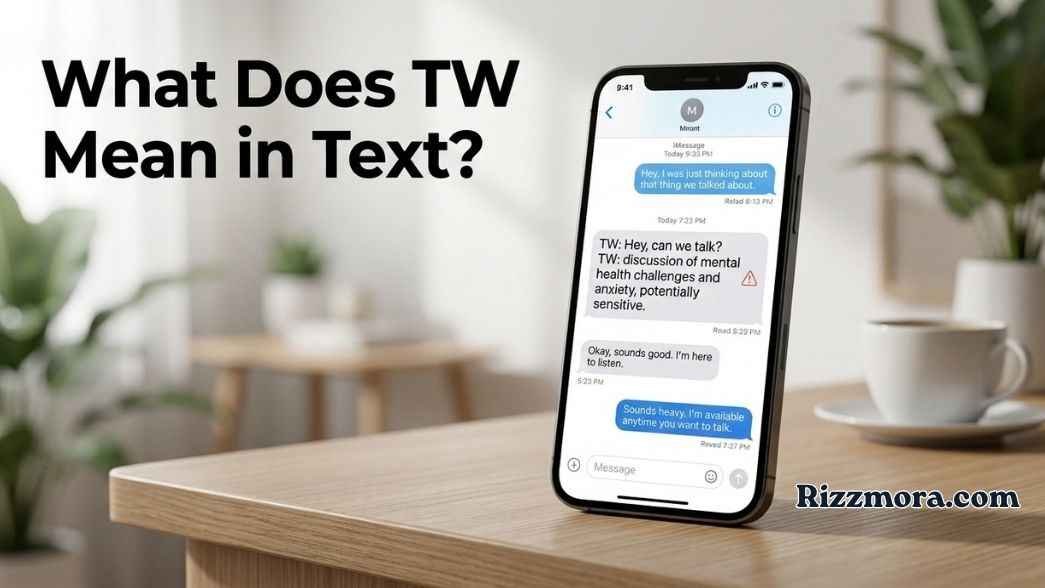
You’re texting a friend about a movie, and they suddenly reply, “TW: that scene is rough.” You pause. What does that little abbreviation mean? This is exactly why people search What Does TW Mean in Text when they see it in a message, caption, or comment.
In most online conversations, TW means “trigger warning.” It’s used before content that could be upsetting, disturbing, or emotionally difficult for some people. You’ll often see it before discussions of violence, abuse, self-harm, trauma, eating disorders, or other sensitive subjects.
The meaning can change in a different setting, though. “TW” may also stand for other phrases depending on the conversation, community, or platform. Context matters more than the two letters alone.
I’ve noticed that abbreviations like this can look obvious to regular social media users but confusing when you encounter them for the first time. So, let’s break down What Does TW Mean in Text with simple explanations, examples, and situations where using it makes sense.
Quick Answer: What Does TW Mean?
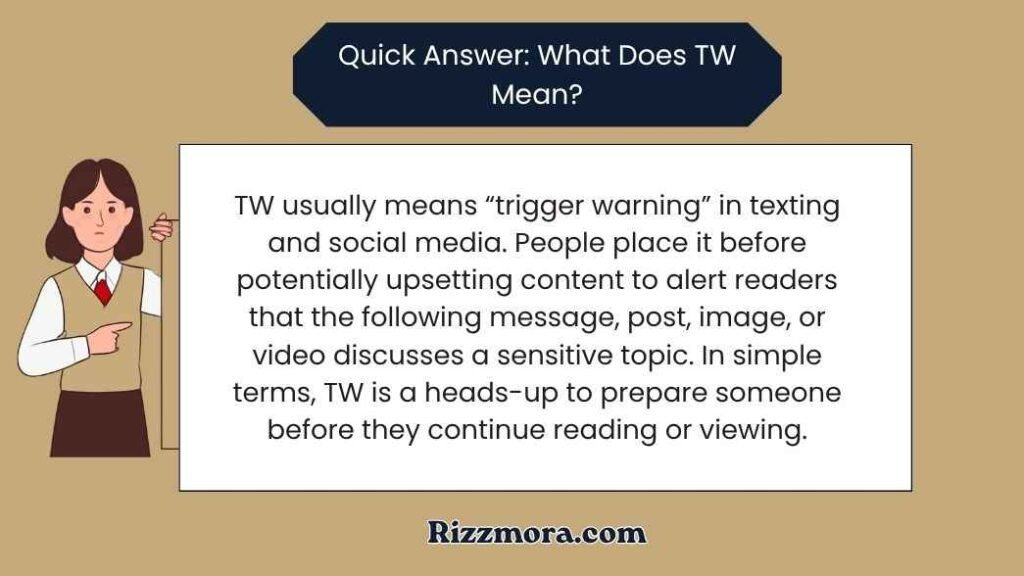
TW usually means “trigger warning” in texting and social media. People place it before potentially upsetting content to alert readers that the following message, post, image, or video discusses a sensitive topic. In simple terms, TW is a heads-up to prepare someone before they continue reading or viewing.
A: TW: This story mentions a serious accident.
B: Thanks for the warning.
Detailed Meaning Breakdown
Primary Meaning
The most common meaning of TW is “trigger warning.” A person uses it to signal that what follows may bring up difficult emotions or memories for some readers.
For example:
“TW: violence. The next part of the story gets pretty intense.”
The warning doesn’t necessarily mean everyone will find the material upsetting. It simply gives people a chance to decide whether they want to continue.
This usage is especially common in online communities, social media posts, blogs, forums, and private messages where people may discuss sensitive experiences.
A trigger warning is usually short. You don’t need a long explanation. The topic itself often follows the abbreviation.
Secondary Meanings
Although “trigger warning” is the dominant internet meaning, TW can represent other phrases in specific conversations.
Depending on the subject, it might refer to a person’s initials, a company, a game-related term, a location, or an unrelated abbreviation. Some communities also use “TW” as shorthand for words that have nothing to do with warnings.
For example, someone discussing technology might use an abbreviation differently from someone discussing entertainment.
That’s why seeing TW alone isn’t enough to determine its meaning with absolute certainty. Look at the words immediately before and after it.
Rare or Misinterpreted Meanings
One common mistake is assuming every “TW” means a trigger warning.
If someone writes:
“TW is coming out next week.”
the meaning could be completely different. Without additional context, you shouldn’t automatically interpret it as a content warning.
Another issue is confusing TW with “CW,” which can also mean “content warning.” These terms overlap, but communities may use them differently.
When you’re unsure, checking the surrounding sentence usually solves the mystery. If the abbreviation appears immediately before a sensitive subject, “trigger warning” is probably the intended meaning.
What TW Means in Different Contexts
In Texting and Messaging
In everyday texting, TW generally appears when someone is about to mention something potentially disturbing or emotionally heavy.
A friend might send:
“TW: hospital stuff. I finally got the results.”
Here, the abbreviation prepares the reader for a potentially difficult topic.
Another person might write:
“TW: spoilers and death.”
before discussing a television episode.
In private messages, the use can be more relaxed than in public posts. A close friend may simply write “TW” followed by one or two words.
I’ve found that the surrounding conversation often tells you more than the abbreviation itself. If you’re already discussing a serious subject, the meaning becomes especially clear.
On Social Media Platforms
On Instagram, TW can appear in captions, Stories, comments, or DMs before sensitive material.
On Snapchat, someone might use it before sending a difficult story or image. TikTok creators and commenters may put a warning in text before discussing a serious topic, while Threads users may place it at the beginning of a post.
The exact style varies by community. Some people write “TW:”, while others use “TW —” followed by the subject.
For example:
“TW: grief. This post talks about losing a family member.”
On short-form platforms, the warning is often placed at the very beginning so people notice it before reading further.
In Dating and Relationships
In dating conversations, TW can be useful when someone wants to discuss a sensitive personal experience.
For example:
“TW: toxic relationship. My last relationship was difficult, so I take things slowly now.”
Here, the abbreviation creates a small boundary around the conversation. The sender is telling the other person that the subject may be emotionally heavy.
It can also appear when discussing breakups, abuse, trauma, family problems, or other serious experiences.
If someone sends you a message like this, don’t immediately push for details. A simple response such as “Thanks for letting me know” gives them room to decide how much they want to share.
In Professional Communication
Using TW in workplace communication requires more care.
In a private conversation between coworkers, someone might use it before discussing a distressing event. However, professional emails, reports, and official announcements usually benefit from clear wording rather than unexplained slang.
For example, instead of:
“TW: accident details”
a workplace notice could say:
“Content warning: The following information describes an accident.”
That wording is easier for everyone to understand.
If your audience includes people from different age groups, countries, or professional backgrounds, avoid assuming they know online abbreviations.
Cultural or Regional Differences
The phrase “trigger warning” is widely recognized in English-speaking online communities, but familiarity varies.
Younger social media users may recognize TW immediately, while someone who rarely uses social platforms might not know what it means. The same applies to people learning English or entering a new online community.
Different communities also have different expectations about what deserves a warning.
One group may use TW for discussions of violence, while another may use it for grief or other emotionally sensitive subjects.
📱 Where Is TW Used?
- Snapchat 👻
“TW: This story talks about a serious accident.” - TikTok 🎵
“TW: The video discusses grief and loss.” - Instagram DMs 📩
“TW: I’m going to talk about something difficult from my past.” - WhatsApp 💬
“TW: The news I’m sharing is pretty upsetting.” - Gaming chats 🎮
“TW: The next part of this game contains disturbing scenes.”
The abbreviation is mainly casual or semi-formal. It’s common in online communities and personal conversations but isn’t usually the clearest choice for formal business writing.
Also Read This: What Does FGF Mean in Text
Tone, Psychology & Why People Use It
Why People Use It & What It Signals Socially
A trigger warning communicates consideration and choice.
The sender recognizes that a topic could affect someone emotionally and gives them a moment to decide whether they want to continue.
For example:
“TW: discussion of domestic violence.”
The writer isn’t necessarily saying the content is inappropriate. They’re simply identifying its subject before presenting it.
This can also make conversations feel more respectful. Readers aren’t forced to discover a difficult topic unexpectedly.
Emotional Layer Behind It
The emotional tone depends heavily on the material that follows.
A neutral warning might be:
“TW: medical procedure.”
A more serious one could be:
“TW: abuse and trauma.”
The abbreviation itself is usually neutral. The emotional weight comes from the subject.
If someone uses TW before a personal story, the message may also suggest vulnerability. They could be preparing themselves as much as they’re preparing the reader.
10 Real Conversation Examples (Explained)
1. A Serious News Story
Message: “TW: graphic accident details.”
Meaning: The sender is warning that the following information may be disturbing.
Tone: Serious and cautious.
Likely interpretation: Don’t continue unless you’re comfortable with the subject.
2. A Movie Discussion
Message: “TW: major character death.”
Meaning: The person is warning about upsetting story content.
Tone: Casual but considerate.
Likely interpretation: The warning may also protect someone who doesn’t want emotional spoilers.
3. A Personal Experience
Message: “TW: I talk about my experience with abuse here.”
Meaning: The writer identifies a sensitive topic before sharing their story.
Tone: Vulnerable and serious.
Likely interpretation: The writer wants readers to approach the post carefully.
4. A Friend’s Text
Message: “TW, this hospital story isn’t easy to hear.”
Meaning: The friend is preparing you for a difficult story.
Tone: Personal and gentle.
Likely interpretation: They probably expect an emotional conversation.
5. A TikTok Caption
Message: “TW: eating disorder discussion.”
Meaning: The video contains discussion of that subject.
Tone: Informative and cautious.
Likely interpretation: Viewers can decide whether to watch.
6. An Instagram Story
Message: “TW: grief.”
Meaning: The Story concerns loss or mourning.
Tone: Quiet and emotional.
Likely interpretation: The creator is giving followers a quick heads-up.
7. A Gaming Chat
Message: “TW: disturbing imagery in the next level.”
Meaning: A player warns others about potentially upsetting game content.
Tone: Practical.
Likely interpretation: Teammates can prepare or skip the section.
8. A Relationship Conversation
Message: “TW: talking about my previous abusive relationship.”
Meaning: The person is preparing their partner for a difficult discussion.
Tone: Serious and personal.
Likely interpretation: The sender may appreciate patience rather than immediate questions.
9. A Book Recommendation
Message: “TW: the book includes violence against children.”
Meaning: The person is alerting another reader to sensitive material.
Tone: Helpful and direct.
Likely interpretation: The reader can decide whether the book is suitable for them.
10. An Unclear Abbreviation
Message: “TW starts tomorrow.”
Meaning: Here, TW may not mean trigger warning at all.
Tone: Impossible to determine from the abbreviation alone.
Likely interpretation: You need more context before deciding what TW represents.
Where Misunderstandings Happen
Context Confusion
The biggest problem is assuming TW always means trigger warning.
Abbreviations are highly dependent on context. A message about a sensitive story is very different from a message about an event, organization, or person’s initials.
Read the complete sentence before interpreting it.
Generational Gap
Online language changes quickly.
Someone who spends a lot of time on social media may recognize TW instantly. Another person might see two random letters and wonder what they mean.
This is especially common in family chats or mixed-age workplaces.
Platform Differences
The same abbreviation can feel slightly different across platforms.
A TikTok caption may use TW as a quick public warning, while a private Instagram message may use it more personally. A professional Slack conversation might avoid the abbreviation altogether.
The audience determines how useful the shorthand will be.
Similar Words, Symbols, or Abbreviations
| Term | Meaning | How It Differs from TW |
|---|---|---|
| CW | Content warning | Often broader than a trigger warning |
| Content warning | Notice about sensitive material | Clearer and more formal than TW |
| Trigger warning | Notice about potentially triggering material | This is the most common meaning of TW |
| Spoiler warning | Notice that plot details follow | Focuses on story information, not emotional sensitivity |
| NSFW | Not safe for work | Usually identifies workplace-inappropriate material |
| Heads-up | General advance notice | Doesn’t specifically refer to sensitive topics |
| Caution | General warning | Broader and more formal |
| Sensitive content | Material that may be difficult to view | More descriptive than the abbreviation |
When Not to Use TW
Professional Risks
Don’t assume everyone understands online shorthand.
In a formal email, medical communication, workplace policy, school notice, or customer-facing message, “trigger warning” or “content warning” is usually clearer.
Clarity should come before brevity when the message matters.
Cultural Risks
Not every community agrees about which topics require warnings.
Using TW for every mildly uncomfortable subject may make the abbreviation feel less meaningful. On the other hand, leaving out a warning for clearly sensitive material may surprise readers.
Know your audience.
Tone Risks
A warning can sometimes feel casual if the subject is extremely serious.
For a sensitive personal disclosure, simply writing “TW lol” or adding jokes around the warning can come across as dismissive.
Match the tone of the warning to the seriousness of the subject.
Expert Tips for Using TW Correctly
- Use TW before sensitive material, not after it.
- Add the specific topic when possible.
- Keep the warning short and easy to notice.
- Don’t assume every reader knows the abbreviation.
- Use “content warning” when communicating with a broad or formal audience.
- Don’t use TW simply because something is mildly unpleasant.
- Remember that a warning doesn’t replace thoughtful writing.
- Give readers enough information to make their own choice.
- Pay attention to the community’s usual terminology.
- If someone uses TW and you’re unsure what they mean, ask politely instead of guessing.
Frequently Asked Questions
1. What does TW mean in text messages?
In most text-message and social media contexts, TW means “trigger warning.” It appears before a potentially upsetting topic, such as violence, abuse, grief, trauma, or disturbing imagery. The purpose is to give the reader advance notice so they can decide whether they want to continue reading or discussing the subject.
2. Is TW positive or negative?
TW itself is neither positive nor negative. It’s a neutral warning abbreviation. The emotional feeling comes from the topic that follows it. For example, “TW: violence” signals serious material, while “TW: spoilers” may simply prevent someone from learning a movie detail they wanted to discover themselves.
3. Can TW have a romantic meaning?
TW isn’t normally a romantic abbreviation by itself. However, someone may use it in a romantic conversation before discussing a difficult relationship experience, breakup, abuse, grief, or another sensitive subject. In that situation, the romantic context doesn’t change the basic meaning of TW as a warning.
4. How should I respond when someone sends TW?
A simple response works well. You could say, “Thanks for the warning,” or ask, “Do you want to talk about it?” If the subject seems serious, avoid pressuring the person for details. Let them control how much they want to share and whether they want to continue the conversation.
5. Does TW always mean trigger warning?
No. Context determines the meaning. Trigger warning is the most common interpretation in social media and texting, but TW can represent other words, names, or phrases in different communities. If the surrounding message doesn’t involve sensitive content, consider other possibilities before deciding what the abbreviation means.
6. Is TW the same as CW?
They’re closely related, but they aren’t always used identically. TW usually means trigger warning, while CW commonly means content warning. Some online communities use the terms interchangeably, while others use CW as a broader label for potentially sensitive or disturbing material.
7. Why do people put TW before a post?
People use TW to give readers advance notice about sensitive material. This allows someone to pause, skip the post, or prepare themselves before encountering the subject. It’s particularly common when discussing trauma, violence, abuse, eating disorders, grief, or disturbing imagery.
8. What does TW mean before a TikTok?
Before a TikTok, TW usually signals that the video discusses or displays potentially sensitive material. The creator may then identify the subject, such as “TW: grief” or “TW: medical content.” Because TikTok content moves quickly, placing the warning near the beginning makes it easier for viewers to notice.
Final Summary & Smart Usage Advice
When someone asks What Does TW Mean in Text, the simplest answer is “trigger warning.” It is commonly placed before sensitive material to let readers know that the following message, image, video, or discussion could be emotionally difficult.
You’ll most often encounter TW on social media, in text messages, DMs, online communities, gaming chats, and personal posts. It can introduce subjects such as violence, abuse, grief, trauma, medical experiences, or disturbing scenes.
Still, context matters. TW doesn’t always have one universal meaning. If the conversation doesn’t involve sensitive content, the abbreviation may stand for something completely different.
For casual online conversations, TW can be useful and easy to understand. In professional or mixed-audience settings, spelling out “trigger warning” or “content warning” is often clearer.
The biggest mistake is assuming the abbreviation has the same meaning everywhere. Look at the surrounding words, consider the platform, and think about who is speaking.
You now have a clear understanding of What Does TW Mean in Text, how people use it, and when another phrase may be more appropriate.
The easiest rule to remember: TW usually means “trigger warning,” but context always gets the final say.

Hi, I’m David Martinez, an author at RizzMora with experience writing about texting slang, online expressions, and social media terminology. I like keeping my explanations straightforward so readers can quickly find the meaning they need.