Have you ever received a message containing ISF and wondered what it means? If you’re searching for What Does ISF Mean in Text, you’re probably trying to understand an unfamiliar abbreviation from a friend, a Snapchat message, or a social media comment.
Unlike popular texting slang such as LOL or BRB, ISF doesn’t have one widely recognized meaning in everyday conversations.
Its meaning may depend on the sender, the topic, or the online community. Understanding the context can help you avoid confusion and respond naturally.
In this guide, I’ll explain the possible meanings of ISF, show you real-life texting examples, and help you understand how to respond when someone uses it.
Quick Answer: What Does ISF Mean?
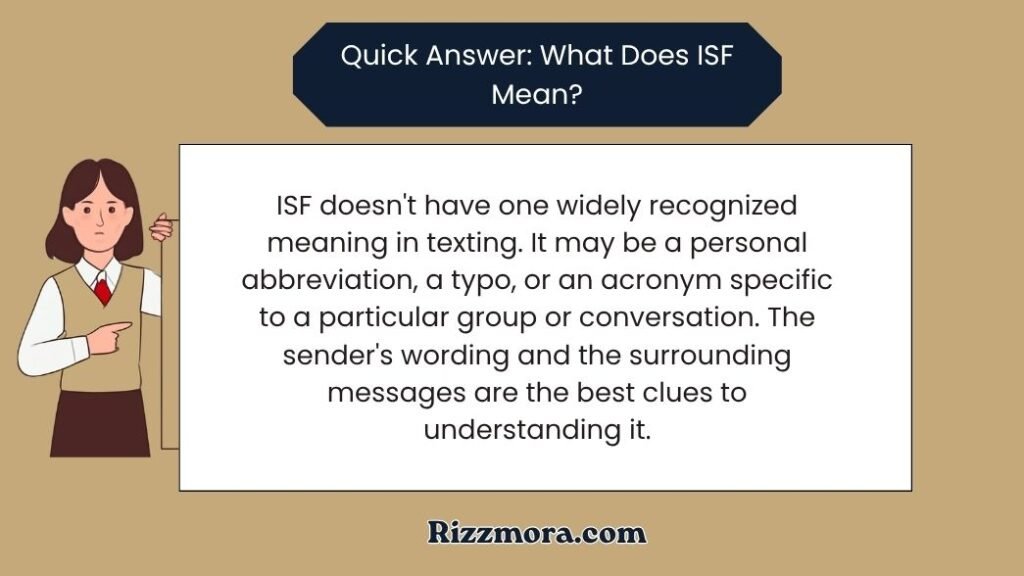
ISF doesn’t have one widely recognized meaning in texting. It may be a personal abbreviation, a typo, or an acronym specific to a particular group or conversation. The sender’s wording and the surrounding messages are the best clues to understanding it.
Example 1:
A: Are you coming to the party? B: ISF
The meaning is unclear without knowing the sender’s intended abbreviation.
Example 2:
A: What does ISF mean? B: I just use it as my own shorthand.
Detailed Meaning Breakdown
Primary Meaning
Unlike popular texting abbreviations such as LOL, BRB, and TBH, ISF doesn’t have a single established primary meaning in everyday texting.
Its interpretation depends on how someone uses it. A person might create their own shorthand to save time, while another might use the same letters for a phrase that only makes sense within a particular friendship.
For example, two friends who regularly use personal abbreviations might understand ISF immediately. Someone outside their group could find it confusing.
When you encounter ISF, avoid assuming that it has a particular meaning without additional context.
Secondary Meanings
ISF can also appear as an acronym outside casual texting. Its meaning may change significantly depending on the subject.
For example, in professional or technical settings, ISF can stand for Importer Security Filing, a term used in international shipping and customs.
In other organizations, it may represent the name of a group, a project, or a specific process.
These meanings don’t automatically apply to a casual message. If someone sends ISF while discussing a shipment, its professional meaning may be relevant. If it appears in a conversation about weekend plans, that interpretation is less likely.
Rare or Misinterpreted Meanings
Some people may assign their own meaning to ISF or use it as a shortened version of a longer phrase. However, there isn’t enough consistent usage to identify one particular informal expansion as the standard.
You might also see someone confuse ISF with another abbreviation, especially when typing quickly on a phone.
For example, a missing letter or an accidental keystroke can make a familiar expression look unfamiliar.
The safest approach is to consider the entire message rather than interpreting three letters on their own.
What ISF Means in Different Contexts
In Texting and Messaging
In everyday texting, abbreviations help people communicate quickly. However, not every combination of letters becomes a widely understood slang term.
ISF may be something a sender uses privately with friends. It could also be a typo or shorthand that makes sense only in the conversation.
Imagine receiving a message that says, “ISF, I’ll tell you later.” Without knowing the sender’s habits or the topic, it’s difficult to determine what the first three letters mean.
If you’re unsure, a simple question such as “What do you mean by ISF?” is usually enough.
There’s no need to pretend you understand an abbreviation when its meaning isn’t clear.
On Social Media Platforms
ISF can appear in comments, direct messages, captions, or posts, but its presence doesn’t establish a universal slang definition.
Each platform has its own communication style.
On Instagram, you might encounter unfamiliar abbreviations in comments or private messages. The surrounding conversation can help you work out whether the letters are an inside joke or something else.
On Snapchat, short messages and quick replies are common. Friends may develop their own shorthand, which can make certain abbreviations difficult for outsiders to understand.
On TikTok, users sometimes create expressions that become popular within a particular community. However, seeing ISF in a video comment doesn’t necessarily mean it’s trending slang.
On Threads, the meaning may depend on the topic of a public discussion or the relationship between people replying to each other.
In every case, the surrounding content matters more than the platform itself.
In Dating and Relationships
When ISF appears in a conversation with someone you’re dating or interested in, it’s natural to wonder whether it has a romantic meaning.
However, ISF isn’t a widely recognized romantic abbreviation. You shouldn’t automatically interpret it as flirting, affection, or rejection.
For example, someone might send ISF during a conversation about making weekend plans. The letters alone don’t reveal whether they’re being playful, serious, or simply using personal shorthand.
Look at the rest of the conversation instead. Does the person usually communicate warmly? Are they discussing something specific? Have they explained the abbreviation before?
If the message still seems confusing, asking directly can prevent unnecessary misunderstandings.
In Professional Communication
In professional communication, ISF may have a specific industry-related meaning.
One established example is Importer Security Filing, a customs requirement associated with shipments entering the United States by ocean vessel.
In a business email about international shipping, ISF may refer to that filing rather than internet slang.
In other workplaces, the same letters might represent an internal project, department, or document. Such meanings are often specific to an organization.
If you receive ISF in a work message, consider the subject before interpreting it. When the meaning affects a task or deadline, ask the sender to clarify.
Cultural or Regional Differences
Texting habits vary between countries, age groups, and online communities. Some expressions are common in one group but unfamiliar to another.
ISF doesn’t have a well-established regional texting meaning that applies consistently across the United States or other English-speaking countries.
You may encounter it in conversations with people who use English as a second language, but that doesn’t mean it has a particular cultural definition.
Personal habits can matter just as much as regional differences. Two people living in the same city may use completely different abbreviations.
It’s better to ask about an unfamiliar expression than to assume that everyone uses it the same way.
Also Read This: What Does SWYD Mean in Text
Where Is ISF Used?
ISF may appear in different online spaces, although its use as casual slang isn’t firmly established.
- Snapchat 👻: A friend might use ISF as personal shorthand in a quick message.
- TikTok 🎵: You may see ISF in a comment, but its meaning depends on the video’s topic.
- Instagram DMs 📩: Someone could use the letters in a private conversation or an inside joke.
- WhatsApp 💬: Friends or family members might create their own meaning for the abbreviation.
- Gaming chats 🎮: ISF could refer to a team-specific phrase, game term, or private shorthand.
In general, ISF should be treated as an informal or context-dependent abbreviation when it appears in casual conversations. Its use in formal or semi-formal communication should depend on whether everyone involved understands the intended meaning.
Tone, Psychology & Why People Use It
Why People Use It and What It Signals Socially
People use abbreviations for several reasons. They may want to type faster, keep a message short, or communicate using language familiar to their friends.
Sometimes, abbreviations also help create a sense of belonging. A group of friends might use expressions that outsiders don’t recognize.
However, ISF doesn’t have a fixed social meaning. Its appearance doesn’t necessarily signal friendliness, secrecy, excitement, or any other emotion.
For instance, a person might use it simply because they’ve seen someone else use it. Another person might have invented it independently.
The important distinction is between the abbreviation itself and the intention behind the message.
Emotional Layer Behind It
The emotional tone of a message depends on the words around an abbreviation.
Consider these situations:
- Friendly: A friend uses ISF in a playful conversation, followed by laughing emojis.
- Neutral: A coworker includes ISF in a message about a shipping document.
- Unclear: Someone sends only ISF without any explanation.
- Confusing: A person uses ISF during an important conversation without explaining what they mean.
The same three letters can appear in very different situations.
If you’re trying to understand someone’s feelings, pay attention to their complete message, their usual communication style, and the subject being discussed.
10 Real Conversation Examples (Explained)
Because ISF has no universally accepted texting definition, these examples show situations in which you might encounter it. The intended meaning is deliberately left open wherever the sender hasn’t explained it.
1. A Message From a Friend
Message: “ISF, I’ll see you tomorrow.”
Intended meaning: Unknown without clarification.
Emotional tone: Casual.
Likely interpretation: Your friend may be using personal shorthand. Ask what the abbreviation means if it affects your plans.
2. A Snapchat Reply
Message: “Why did you write ISF?”
Intended meaning: The sender is asking about an unfamiliar abbreviation.
Emotional tone: Curious.
Likely interpretation: They want an explanation rather than making an assumption.
3. A Conversation About Dating
Message: “You sent ISF. What does that mean?”
Intended meaning: The recipient wants clarification.
Emotional tone: Potentially playful or neutral.
Likely interpretation: The message doesn’t establish romantic interest by itself.
4. An Instagram Comment
Message: “ISF, that’s exactly what happened!”
Intended meaning: Unclear without knowing the original post or the commenter’s vocabulary.
Emotional tone: Possibly enthusiastic.
Likely interpretation: The commenter is reacting to something, but the abbreviation needs context.
5. A WhatsApp Group Chat
Message: “Does anyone know what ISF means?”
Intended meaning: A request for an explanation.
Emotional tone: Neutral.
Likely interpretation: The sender has encountered an unfamiliar expression.
6. A Message From a Coworker
Message: “Please check the ISF paperwork before the shipment.”
Intended meaning: Likely Importer Security Filing in an international shipping context.
Emotional tone: Professional.
Likely interpretation: The sender is referring to shipping documentation.
7. A Gaming Conversation
Message: “Our team keeps using ISF. What is it?”
Intended meaning: A question about team-specific terminology.
Emotional tone: Curious.
Likely interpretation: The abbreviation may be part of the group’s own vocabulary.
8. A Message From a New Friend
Message: “ISF 😂”
Intended meaning: Unknown.
Emotional tone: Possibly playful.
Likely interpretation: The emoji suggests a lighthearted tone, but it doesn’t explain the letters.
9. A TikTok Reply
Message: “Someone explain ISF in this comment.”
Intended meaning: A request to understand an unfamiliar abbreviation.
Emotional tone: Curious.
Likely interpretation: The user has noticed the letters in a social media discussion.
10. A Conversation About Plans
Message: “Are we still meeting? You replied ISF.”
Intended meaning: The recipient is unsure whether the sender confirmed the plans.
Emotional tone: Uncertain.
Likely interpretation: The sender should clarify whether they’re attending.
Where Misunderstandings Happen
Context Confusion
The biggest problem with ISF is that it doesn’t have one widely accepted texting definition.
A person may interpret it as a familiar expression from their own group, while someone else has never encountered it.
This can create confusion, particularly when the abbreviation appears without any additional words.
For example, a short reply containing only ISF may leave the recipient unsure whether the sender is agreeing, disagreeing, or referring to something else.
Generational Gap
Different age groups often develop different texting habits.
Younger users may recognize expressions from social media communities that older users rarely visit. Older users may also use workplace or personal abbreviations that younger people don’t recognize.
However, age alone doesn’t determine whether someone understands ISF.
The abbreviation’s meaning depends more on the individual and the setting than on a person’s generation.
Platform Differences
An abbreviation can have a different meaning in a gaming chat than in a professional email.
Social media also encourages people to use personal shorthand, especially in private conversations.
However, there is no reliable basis for assigning ISF a separate standard meaning on Instagram, TikTok, Snapchat, or WhatsApp.
Always consider the original message and the community where it appeared.
Similar Words, Symbols, or Abbreviations
The following abbreviations are more widely recognized in everyday digital communication. They’re useful comparisons when trying to understand unfamiliar messages.
| Term | Meaning | How It Differs from ISF |
|---|---|---|
| LOL | Laughing out loud | A widely recognized reaction to something funny. |
| BRB | Be right back | Tells someone you’ll return shortly. |
| TBH | To be honest | Introduces an honest opinion or statement. |
| IDK | I don’t know | Clearly expresses uncertainty. |
| IMO | In my opinion | Introduces a personal viewpoint. |
| FYI | For your information | Shares information someone may need. |
| IKR | I know, right? | Shows agreement or shared understanding. |
| SMH | Shaking my head | Often expresses disappointment or disbelief. |
| NGL | Not gonna lie | Introduces a candid statement. |
| TTYL | Talk to you later | Signals that a conversation is ending. |
Unlike these familiar abbreviations, ISF doesn’t have one consistently established meaning in casual texting.
When Not to Use ISF
Professional Risks
Avoid using ISF in a work email or business message unless the intended meaning is clear to everyone involved.
In industries such as international shipping, ISF already has a specific meaning. Using it casually in that environment could create confusion.
If you’re discussing a deadline, shipment, or important task, use the complete phrase the first time you mention it.
Clear communication is more useful than saving a few keystrokes.
Cultural Risks
Don’t assume that people from a particular country, community, or age group understand ISF.
An abbreviation that makes sense to your friends may be unfamiliar to someone outside your social circle.
When communicating with people from different backgrounds, use simple language and explain unfamiliar terms.
Tone Risks
Sending an unexplained abbreviation during an emotional conversation can make your message harder to understand.
For example, if someone is asking you an important question, replying with ISF may leave them uncertain about your response.
When the conversation matters, use complete words. A clear sentence can prevent unnecessary confusion.
Expert Tips for Using ISF Correctly
Here are some practical ways to handle ISF when you encounter it online.
- Check the conversation: Read the messages before and after ISF to understand the subject.
- Consider the sender: Think about whether the person commonly uses personal abbreviations.
- Look for an explanation: The sender may have defined the abbreviation earlier in the conversation.
- Don’t assume it’s slang: It could be a typo, technical term, or private expression.
- Ask a simple question: If the meaning isn’t clear, ask the sender directly.
- Consider the platform: A gaming group may use terminology that doesn’t make sense elsewhere.
- Avoid guessing in serious conversations: Confirm the meaning before responding to important information.
- Use familiar abbreviations instead: If you’re writing to a broad audience, choose expressions people are more likely to understand.
- Explain personal shorthand: If you regularly use ISF with friends, tell them what you mean.
These small habits make online conversations easier and help prevent misunderstandings.
Frequently Asked Questions
1. What does ISF mean in text messages?
ISF doesn’t have one widely accepted meaning in everyday text messages. It may be a personal abbreviation, a typo, or shorthand used within a particular group. The surrounding conversation is the best way to understand it. If the meaning isn’t obvious, asking the sender is the simplest solution.
2. Is ISF a positive or negative abbreviation?
ISF isn’t inherently positive or negative. Its emotional meaning depends on the words surrounding it and the sender’s intention. A message containing ISF could be casual, serious, or playful. Without additional context, you shouldn’t interpret it as praise, criticism, agreement, or rejection.
3. Does ISF have a romantic meaning?
There isn’t a widely established romantic meaning for ISF in texting. If someone you’re interested in sends it, consider the rest of your conversation rather than assuming it’s flirting. You can ask what they meant if you’re unsure. Their explanation will provide more reliable information than the abbreviation alone.
4. How should I respond when someone texts ISF?
Your response should depend on the conversation. If you don’t understand the abbreviation, simply ask, “What does ISF mean?” If the sender has already explained it, respond to the actual message. Avoid guessing when the abbreviation is part of an important discussion.
5. Does ISF mean the same thing on Snapchat and Instagram?
Not necessarily. Both platforms support casual messages and personal shorthand, but ISF doesn’t have a confirmed universal meaning on either one. A person might use it differently depending on their friends or online community. Always consider the original message instead of relying on the platform.
6. Is ISF commonly used by Gen Z?
ISF isn’t established as a widely recognized Gen Z texting abbreviation. Some younger users may encounter it in specific online communities or private conversations. However, seeing it used by one person doesn’t mean it’s popular among an entire generation. Its meaning should be checked in context.
7. What does ISF mean in shipping?
In international shipping, ISF commonly means Importer Security Filing. It is a customs-related filing associated with cargo arriving in the United States by ocean vessel. This professional meaning is different from casual texting. If you encounter ISF in a shipment-related email, the customs meaning may be relevant.
8. Can ISF be a typo in a text message?
Yes, it could be a typo. People often type quickly on their phones, and an accidental keystroke can produce unfamiliar letter combinations. However, you shouldn’t automatically assume that ISF is a typing mistake. Check the message and ask the sender if the intended meaning remains unclear.
Final Summary & Smart Usage Advice
Understanding ISF is mostly about recognizing the limits of texting abbreviations. Unlike familiar expressions such as LOL, BRB, and IDK, ISF doesn’t have one universally accepted meaning in everyday messaging.
It may be personal shorthand, a typo, or an acronym used in a specific community. In professional settings, it can also stand for Importer Security Filing, particularly when people are discussing international shipping.
If you see ISF in a Snapchat message, Instagram DM, TikTok comment, or WhatsApp group, pay attention to the surrounding conversation. The sender’s usual communication style and the topic can offer useful clues.
When you’re still unsure, asking for clarification is perfectly normal. There’s no reason to guess what someone means, especially if the message involves important plans or personal feelings.
If you decide to use ISF yourself, make sure the people you’re communicating with understand it. For conversations with new friends, coworkers, or a wider audience, familiar words are usually clearer.
You now have the information needed to recognize the different ways ISF might appear and avoid confusing it with established texting slang.
The key takeaway: Never assume an unfamiliar abbreviation has one meaning. Context and clarification matter most.

Hi, I’m Patricia Davis, a writer at RizzMora with experience covering social media language, Gen Z slang, and common texting terms. I enjoy turning unfamiliar expressions into quick, easy-to-follow explanations.
One thought on “What Does ISF Mean in Text? Meaning, Context, Examples, and Modern Usage (2026 Guide)”