Imagine getting a text that says, “ARD, I’ll see you later,” and wondering whether the sender just made a typo. You’re not alone. ARD is a short texting abbreviation that can look confusing if you haven’t seen it before.
If you’re asking What Does ARD Mean in Text, the short answer is usually “alright” or “all right.” It’s most common in casual conversations, where people shorten words to type faster and keep messages relaxed.
The term can appear in texts, social media comments, direct messages, gaming chats, and other informal online conversations. Its exact feeling depends on the surrounding message. “ARD 😂” can feel friendly, while “ard.” might sound brief or slightly cold.
People are also searching for this abbreviation because texting slang changes quickly, and a short expression can have different meanings depending on who uses it.
Let’s break down ARD so you can recognize it, understand its tone, and know when it’s safe to use.
Quick Answer: What Does ARD Mean?
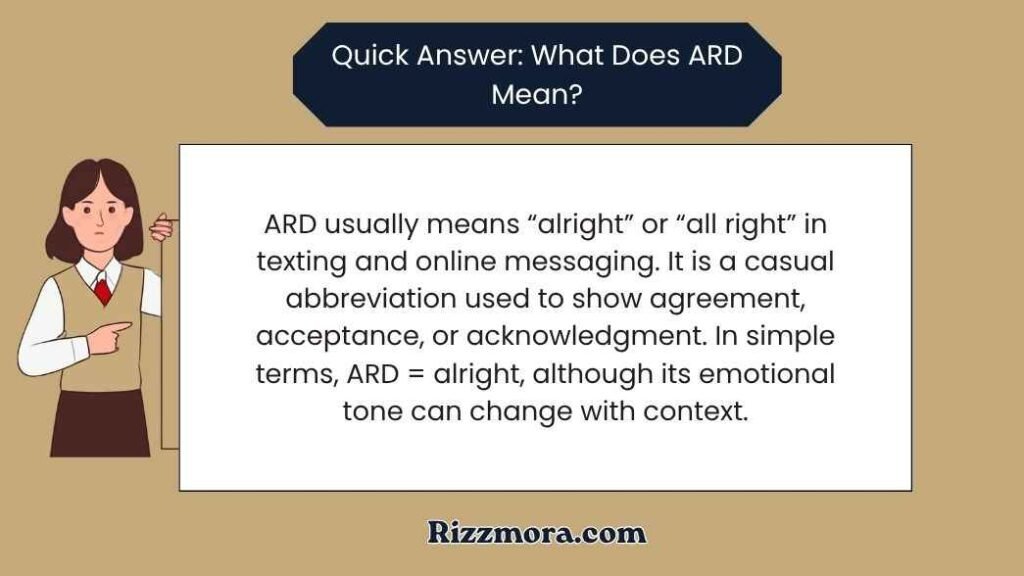
ARD usually means “alright” or “all right” in texting and online messaging. It is a casual abbreviation used to show agreement, acceptance, or acknowledgment. In simple terms, ARD = alright, although its emotional tone can change with context.
A: “You coming at 8?”
B: “ARD.”
A: “I’ll send it tonight.”
B: “ARD 👍”
Detailed Meaning Breakdown
Primary Meaning
The most common meaning of ARD is “alright.” Someone may use it instead of typing the complete word because the shorter form feels quicker and more casual.
For example, “ARD, see you soon” generally means “Alright, see you soon.” There’s usually nothing complicated behind it.
I’ve noticed that short abbreviations often look more serious than they actually are when they appear without context. ARD is a good example.
Secondary Meanings
Depending on the conversation, ARD can communicate several closely related ideas:
- Agreement: “ARD, let’s do it.”
- Acceptance: “ARD, that works.”
- Acknowledgment: “ARD, got you.”
- Confirmation: “ARD, I’ll be there.”
- Conversation closure: “ARD, talk later.”
The underlying idea remains similar: okay, alright, or understood.
Rare or Misinterpreted Meanings
ARD can have other meanings outside casual texting. In specialized settings, it may represent a name, organization, technical term, or abbreviation unrelated to texting slang.
That’s why context matters. If you see ARD in a work document, medical discussion, academic material, or technical message, don’t automatically assume it means “alright.”
For ordinary texting, however, “alright” is the most likely interpretation.
What ARD Means in Different Contexts
In Texting and Messaging
In everyday texting, ARD usually works as a quick acknowledgment. A person might send “ARD” after receiving plans, instructions, or an invitation.
For example: “Meet me outside when you get here.” → “ARD, will do.”
The abbreviation is especially natural between friends who already have a relaxed communication style.
On Social Media Platforms
On Instagram, Snapchat, TikTok, and Threads, ARD can appear in comments, captions, stories, and DMs. The basic meaning stays close to “alright,” but the tone depends heavily on the post and relationship.
A TikTok commenter might write “ARD 😂” as a playful reaction. In an Instagram DM, “ARD bet” could simply mean “Alright, sounds good.”
Platform culture can influence how casual the abbreviation feels, but it doesn’t normally create a completely different definition.
In Dating and Relationships
In romantic conversations, ARD can mean agreement or acknowledgment without necessarily carrying a romantic meaning itself.
For example, someone might say, “I’ll text you after work.” The reply “ARD ❤️” could mean “Alright,” with the heart adding warmth.
However, “ARD” by itself doesn’t prove that someone is flirting, interested, upset, or losing interest. The surrounding conversation tells you much more.
In Professional Communication
ARD is generally better suited to informal workplace chats than formal emails, reports, applications, or client communication.
A teammate you know well might write, “ARD, I’ll handle it.” That can be perfectly understandable. A customer, manager, or new business contact may expect clearer wording such as “Sounds good” or “Understood.”
When professionalism matters, spell out the response.
Cultural or Regional Differences
The use of ARD can vary by age, social group, and online community. Younger people who frequently use texting abbreviations may recognize it immediately, while someone unfamiliar with internet slang may wonder whether it is a typo.
In some communities, ARD may also be influenced by regional speech patterns. Still, “alright” remains the safest interpretation in casual messaging when no other context suggests otherwise.
Where Is ARD Used?
- Snapchat 👻 — “ARD, I’ll snap you when I get home.”
- TikTok 🎵 — “ARD 😂 that was actually funny.”
- Instagram DMs 📩 — “ARD, send me the address.”
- WhatsApp 💬 — “ARD, we’ll meet at six.”
- Gaming chats 🎮 — “ARD, queue up.”
ARD is primarily casual. It can appear in semi-formal conversations between people who know each other, but it’s usually not the best choice for formal writing.
Also Read This: What Is the 222 Angel Number Meaning
Tone, Psychology & Why People Use It
Why People Use It & What It Signals Socially
People use ARD because texting rewards speed and simplicity. Short forms also make conversations feel less formal.
Someone who writes “ARD” may be signaling, “I understand,” “That’s fine,” or “Okay, let’s move on.” It often creates a laid-back tone without requiring a full sentence.
The relationship matters, too. Friends can use very short replies without sounding rude because they already understand each other’s communication style.
Emotional Layer Behind It
ARD can sound friendly, neutral, or cold depending on punctuation and surrounding words.
“ARD 😂” feels playful. “ARD, sounds good” feels cooperative. A bare “ard.” after an emotional message might feel dismissive, especially if the sender normally writes longer replies.
That doesn’t automatically mean something is wrong. Short replies are easy to overread.
10 Real Conversation Examples Explained
- Message: “I’ll pick you up at 7.”
Reply: “ARD.”
Meaning: The person accepts the plan. Tone: Neutral and casual. Likely interpretation: “Okay.” - Message: “Want to play later?”
Reply: “ARD bro.”
Meaning: They agree to play. Tone: Friendly. Likely interpretation: Relaxed acceptance. - Message: “Send me the photo when you can.”
Reply: “ARD, one sec.”
Meaning: They acknowledge the request. Tone: Cooperative. Likely interpretation: They intend to do it. - Message: “We’re changing the meeting to Friday.”
Reply: “ARD, thanks.”
Meaning: The new plan is understood. Tone: Polite but informal. Likely interpretation: Confirmation. - Message: “I don’t think I can make it tonight.”
Reply: “ARD.”
Meaning: Acceptance of the cancellation. Tone: Neutral, though possibly distant. Likely interpretation: “Okay.” - Message: “That movie was wild 😂”
Reply: “ARD 😂”
Meaning: Agreement with the reaction. Tone: Playful. Likely interpretation: “For real.” - Message: “Can you call me after work?”
Reply: “ARD ❤️”
Meaning: Agreement with added warmth. Tone: Affectionate. Likely interpretation: Friendly or romantic depending on the relationship. - Message: “I sent the files.”
Reply: “ARD, got them.”
Meaning: Confirmation that the files were received. Tone: Direct. Likely interpretation: No emotional subtext. - Message: “Stop joking around and listen.”
Reply: “Ard, my bad.”
Meaning: The person accepts the correction. Tone: Apologetic. Likely interpretation: They’re trying to settle the situation. - Message: “Are you still coming?”
Reply: “ARD.”
Meaning: Possibly “alright,” but the context is unclear. Tone: Potentially flat. Likely interpretation: Ask a follow-up if the answer matters.
Where Misunderstandings Happen
Context Confusion
A short abbreviation doesn’t carry much emotional information. Readers may assign a tone that the sender never intended.
“ARD” after good news may feel perfectly friendly. The same reply after an argument may seem dismissive.
Generational Gap
Not everyone knows the same texting slang. Someone who rarely uses abbreviations may read ARD as a typo or unfamiliar acronym.
If you’re messaging someone outside your usual social circle, clearer wording can prevent confusion.
Platform Differences
A casual abbreviation may feel normal in Snapchat or gaming chat but less appropriate in a professional LinkedIn message or formal email.
The platform sets expectations for how informal the conversation should be.
Similar Words, Symbols, or Abbreviations
| Term | Meaning | How It Differs from ARD |
|---|---|---|
| OK | Agreement or acknowledgment | More universal and less slang-heavy |
| Alright | Agreement or acceptance | Full-word form of the common ARD meaning |
| K | Okay | Much shorter and can sound colder |
| Bet | Agreement or confirmation | Often carries a stronger “yes, definitely” feeling |
| Aight | Alright | Similar slang form with a more pronounced casual tone |
| Yep | Yes | Direct agreement rather than general acknowledgment |
| Gotcha | I understand | Focuses more on understanding |
| Sure | Yes or acceptance | Can sound polite or uncertain depending on context |
| Cool | Sounds good | Often adds a positive or relaxed feeling |
When Not to Use ARD
Professional Risks
Avoid ARD in formal emails, job applications, reports, official messages, and important customer communication. The abbreviation may look careless or overly casual.
Cultural Risks
Don’t assume everyone understands texting slang. If you’re communicating across age groups or cultures, “alright” is clearer.
Tone Risks
A one-word ARD reply can sometimes appear uninterested. If the conversation is emotional or important, add a few words so your intention is obvious.
Expert Tips for Using ARD Correctly
- Use ARD mainly in casual conversations.
- Treat “alright” as the default meaning.
- Read the surrounding messages before interpreting its tone.
- Add punctuation or another word when clarity matters.
- Use emojis only when they naturally fit the relationship.
- Avoid it in formal business writing.
- Don’t assume ARD is romantic just because it appears in a dating conversation.
- If someone seems confused, simply say “I meant alright.”
- Consider the other person’s age and texting habits.
- When in doubt, write the full word instead.
Frequently Asked Questions
1. What does ARD mean in text messages?
ARD usually means “alright” or “all right.” It is an informal abbreviation used to acknowledge something, agree with a plan, or show that a message was understood. For example, “ARD, see you later” means “Alright, see you later.” The surrounding conversation determines whether the response feels friendly, neutral, or slightly distant.
2. Is ARD positive or negative?
ARD isn’t inherently positive or negative. Its tone comes from context. “ARD 😂” may sound cheerful, while “ard.” after an argument could seem cold. If you’re trying to understand someone’s feelings, look at their complete message, punctuation, previous replies, and relationship with you rather than relying on the abbreviation alone.
3. Can ARD be romantic?
Yes, ARD can appear in romantic conversations, but the abbreviation itself isn’t romantic slang. A partner might use it simply to say “alright.” Extra wording, emojis, nicknames, or the broader conversation can create a romantic tone. Don’t treat ARD alone as proof that someone is flirting or expressing affection.
4. How should I respond to ARD?
The best response depends on what came before it. If you were confirming plans, you may not need to reply at all. If you need clarity, continue with the next detail. For example, after “ARD,” you could say, “Great, see you at 7.” Keep your response as casual or formal as the conversation requires.
5. Is ARD the same as AIGHT?
They’re similar because both can represent “alright.” However, AIGHT is a more recognizable slang spelling of “alright” in some online communities, while ARD is another shortened form. Neither has to carry a special emotional meaning. Usage depends largely on personal texting habits and social group.
6. Why do people type ARD instead of alright?
The main reason is convenience. Texting abbreviations let people respond quickly without typing every letter. ARD can also make a message feel relaxed and informal. Some people naturally pick up abbreviations from friends, social media, gaming communities, or repeated online conversations.
7. Does ARD mean “are you ready”?
It can represent different phrases in specialized contexts, but casual text users most commonly understand ARD as “alright.” If someone writes ARD in a situation involving preparation or an event, context could change the interpretation. When the meaning isn’t obvious, asking the sender is safer than guessing.
8. Is ARD appropriate for work messages?
It depends on the workplace and the person you’re messaging. Among close coworkers using casual chat, ARD may be understood without a problem. For clients, managers, formal announcements, or important written records, use “alright,” “understood,” or “sounds good.” Those options communicate the same idea more clearly and professionally.
Final Summary & Smart Usage Advice
ARD is usually a simple texting abbreviation for “alright” or “all right.” People use it to agree, acknowledge a message, confirm a plan, or show that they understand.
You’ll most often encounter it in casual texts, social media DMs, gaming conversations, and chats between friends. It can also appear in dating conversations, but ARD itself isn’t a romantic abbreviation.
The biggest thing to remember is context. A friendly “ARD 😂” isn’t likely to carry the same feeling as a blunt “ard.” after an argument. Punctuation, emojis, relationship history, and the rest of the conversation all help reveal the intended tone.
If you’re unsure how someone meant it, don’t overanalyze one short reply. Look at the whole conversation.
For your own messages, use ARD when the setting is relaxed and the other person is comfortable with texting slang. Choose the full word when clarity or professionalism matters.
The easiest rule: ARD usually means “alright”—but the conversation around it tells you how it feels.

Hi, I’m David Martinez, an author at RizzMora with experience writing about texting slang, online expressions, and social media terminology. I like keeping my explanations straightforward so readers can quickly find the meaning they need.
One thought on “What Does ARD Mean in Text? Meaning, Context, Examples, and Modern Usage (2026 Guide)”