Have you ever opened a text, comment, or group chat and seen “FOE” used in a way that made you pause? Maybe someone wrote, “He’s my foe now,” after a small argument, or you saw the word in a gaming chat. If you’re wondering What Does FOE Mean in Text, the answer is usually simpler than it first appears. Foe means an enemy, rival, or opponent, and in casual online conversations, it can sometimes be used in a playful or exaggerated way.
I’ve noticed that words like this can be confusing because texting often removes the clues we normally get from voice and facial expressions. A serious statement and a joke can look almost identical on a screen.
The word can also feel different depending on the relationship between the people using it. Friends might call each other “foes” while joking around, while someone in a heated conversation may use it more seriously.
Below, we’ll break down FOE’s meaning, common contexts, tone, examples, and the situations where using it may cause confusion.
Quick Answer: What Does FOE Mean?
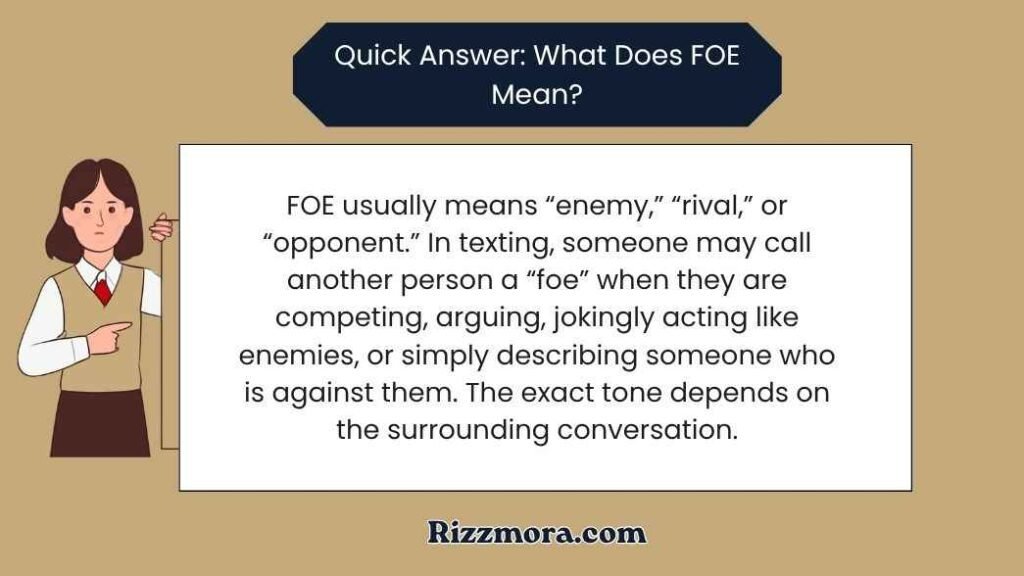
FOE usually means “enemy,” “rival,” or “opponent.” In texting, someone may call another person a “foe” when they are competing, arguing, jokingly acting like enemies, or simply describing someone who is against them. The exact tone depends on the surrounding conversation.
A: “You beat me again.”
B: “Your biggest foe is back 😂”
A: “Are you serious?”
B: “Yep, I’m your foe now.”
In simple terms, FOE = an enemy, rival, or opponent, although friends sometimes use it playfully.
Detailed Meaning Breakdown
Primary Meaning
The most direct meaning of foe is enemy. It describes a person, group, or sometimes even a thing that is opposed to someone else.
For example, someone might text:
“He’s my biggest foe at work.”
Here, the speaker probably means that the other person is a rival or someone competing against them.
The word isn’t necessarily as aggressive as “enemy” sounds. In casual conversation, people can use it dramatically for something much less serious. A friend who always beats you at video games might jokingly become your “foe.”
That playful use is especially common when people enjoy exaggerating ordinary competition.
Secondary Meanings
FOE can also refer to a rival or opponent rather than a true enemy.
For example:
“My foe is waiting for the rematch.”
This could describe an opponent in a game, sports competition, debate, or friendly challenge.
The distinction matters. An enemy usually suggests hostility, while a rival may simply be someone competing with you.
In texting, context often determines which meaning makes more sense. If two friends are competing over a video game, “foe” is likely humorous. If someone is discussing a serious disagreement, it may have a stronger meaning.
Rare or Misinterpreted Meanings
One common mistake is assuming that every appearance of FOE is a secret texting acronym.
It isn’t.
Sometimes foe is simply the regular English word. Capital letters may be used because the writer likes uppercase text, because of autocorrect, or because the word appears inside an acronym.
FOE can also appear as an abbreviation for organizations or phrases unrelated to texting slang. That means you shouldn’t automatically assign one meaning to every uppercase “FOE.”
When you’re unsure, look at the words around it. The surrounding sentence usually provides the strongest clue.
What FOE Means in Different Contexts
In Texting and Messaging
In ordinary texting, foe generally describes someone who is considered an enemy, rival, or opponent.
For example:
“You stole my last slice. You’re officially my foe.”
This probably isn’t a serious declaration of hatred. The exaggerated word makes the message funny.
Another person might say:
“I finally defeated my foe.”
If the conversation is about gaming, sports, or another competition, “foe” simply means opponent.
One thing I’ve found interesting about this word is that it can make an ordinary situation sound dramatic. Calling someone a “foe” often feels more theatrical than calling them a “rival.”
On Social Media Platforms
On Instagram, Snapchat, TikTok, and Threads, FOE can appear in captions, comments, replies, or direct messages.
On Instagram, someone might write:
“My gym foe finally lost.”
The word could describe a friendly competitor.
On Snapchat, it may appear in a quick joke:
“My little brother is my greatest foe.”
TikTok comments can use “foe” dramatically when discussing a funny rivalry, game, fictional character, or creator.
Threads may use the word in a more conversational way, especially when someone is joking about an argument or disagreement.
There isn’t one special Instagram, TikTok, or Snapchat definition. The basic meaning stays connected to enemy, rival, or opponent. What changes is the tone created by the post and community.
In Dating and Relationships
In dating conversations, foe can be serious, playful, or sarcastic.
A person might text:
“Your ex is still my foe.”
That sounds more serious because the word is being used in a conflict-related context.
Friends or couples can also use it jokingly:
“You took the last cookie. You’re my foe tonight.”
Here, there is no real hostility. The word is simply playful exaggeration.
If someone calls you a foe during a romantic conversation, don’t immediately assume they dislike you. Check the rest of the message and the relationship between you.
In Professional Communication
The word can technically be understood in professional settings, but it’s not always the best choice.
For example:
“Our main foe is rising competition.”
A reader will understand that “foe” means an opposing competitor. However, “competitor,” “challenge,” or “obstacle” may sound more precise in a workplace setting.
In an email, calling a coworker your “foe” could also sound hostile even if you intended it as a joke.
Professional communication usually benefits from clearer language. If there is any chance the reader could misunderstand your tone, choose a neutral word instead.
Cultural or Regional Differences
The basic English meaning of foe is widely understood, but the emotional feel can vary.
Older or more formal English may use “foe” as a literary alternative to “enemy.” Younger speakers may use it humorously because the word sounds dramatic.
In online communities, especially gaming and fandom spaces, “foe” can feel completely normal when discussing opponents.
Age also matters. Someone familiar with traditional or literary English may hear “foe” as formal, while another person may read it as internet humor.
So the meaning usually stays stable, but the tone can shift significantly.
Also Read This: What Does PSMO Mean in Text
📱 Where Is FOE Used?
- Snapchat 👻
“My brother became my foe after stealing my charger.” - TikTok 🎵
“Bro really found his final foe in the comments.” - Instagram DMs 📩
“You beat me twice, so you’re officially my foe.” - WhatsApp 💬
“My cousin is my gaming foe every weekend.” - Gaming chats 🎮
“Watch out, the strongest foe is coming.”
Overall, FOE is casual rather than formal when used in everyday online conversation. It’s most natural among friends, gamers, social media users, and people who are comfortable with playful language. In formal messages, “enemy,” “opponent,” “rival,” or “competitor” may communicate the idea more clearly.
Tone, Psychology & Why People Use It
Why People Use It & What It Signals Socially
People use foe because it can communicate opposition without always sounding completely serious.
Imagine two friends competing in a game. One loses three times and texts:
“You are officially my foe.”
The word adds drama to the situation. Saying “You’re my opponent” would be accurate, but it wouldn’t have the same playful feeling.
This is one reason unusual or slightly old-fashioned words can become fun in casual messaging. They give people a way to exaggerate an ordinary event.
The word can also signal competition. If someone says, “She’s my biggest foe,” they may be telling you that the person is a serious rival.
Emotional Layer Behind It
The emotional tone depends heavily on context.
A friendly tone might look like:
“You beat me again, foe 😂”
A neutral tone could be:
“Our team faces its strongest foe tomorrow.”
A cold or hostile tone might be:
“Don’t contact me again. You’re my foe now.”
The same word can therefore carry very different emotions.
Punctuation matters too. A laughing emoji, playful wording, or exaggerated statement can soften the term. A short sentence with no extra context may feel much more serious.
10 Real Conversation Examples (Explained)
1. Friendly Competition
Message: “You’re my foe until I win the rematch.”
Intended meaning: The person wants to beat their friend in a competition.
Tone: Playful and competitive.
Likely interpretation: The rivalry isn’t serious.
2. Gaming
Message: “That boss is the hardest foe I’ve faced.”
Intended meaning: The boss is a difficult enemy in the game.
Tone: Neutral and descriptive.
Likely interpretation: FOE means an in-game opponent or enemy.
3. Sports
Message: “Our biggest foe this season is coming Saturday.”
Intended meaning: Another team is a major competitor.
Tone: Competitive but not necessarily hostile.
Likely interpretation: Foe means rival.
4. Sibling Joke
Message: “My sister ate my leftovers. She’s my foe today.”
Intended meaning: The speaker is jokingly annoyed.
Tone: Humorous.
Likely interpretation: There is no real hatred involved.
5. Serious Disagreement
Message: “After what happened, I consider him a foe.”
Intended meaning: The speaker now views the person as an adversary.
Tone: Serious and negative.
Likely interpretation: The relationship has experienced genuine conflict.
6. Social Media Debate
Message: “I found my new foe in the comments.”
Intended meaning: Someone strongly disagreed with the speaker.
Tone: Dramatic and possibly humorous.
Likely interpretation: The speaker is exaggerating an online disagreement.
7. Romantic Teasing
Message: “You stole my fries. You’re officially my foe.”
Intended meaning: The speaker is playfully pretending to be angry.
Tone: Flirty or playful.
Likely interpretation: The word isn’t being used literally.
8. Work Competition
Message: “That company has become our biggest foe.”
Intended meaning: Another company is a major competitor.
Tone: Competitive and business-focused.
Likely interpretation: Foe means business rival.
9. Historical Discussion
Message: “The king faced several foes during his reign.”
Intended meaning: The king faced enemies or opposing forces.
Tone: Formal and historical.
Likely interpretation: This is the traditional meaning of the word.
10. Group Chat Humor
Message: “Whoever changed the Wi-Fi password is my foe.”
Intended meaning: The speaker is jokingly blaming someone.
Tone: Light and exaggerated.
Likely interpretation: The person isn’t genuinely declaring war on anyone.
These examples show why context matters. FOE doesn’t automatically indicate anger. The surrounding words, relationship, situation, and punctuation all help determine the intended tone.
Where Misunderstandings Happen
Context Confusion
The biggest problem occurs when someone sees foe without knowing the situation.
For example, “He’s my foe” could describe a serious enemy, a gaming opponent, or a friend involved in a silly rivalry.
If the message seems unclear, read the previous few messages before deciding what the person means.
Generational Gap
Some people may recognize “foe” immediately because they have encountered it in books, movies, history, or formal writing.
Others may find it unusual because they rarely use the word in everyday speech.
A younger texter might use it ironically, while an older reader could interpret it more literally.
Platform Differences
A word can feel different depending on where you see it.
In a gaming chat, “foe” naturally suggests an enemy or opponent. On Instagram, it may be playful. In a work email, it could sound unnecessarily dramatic.
The platform doesn’t completely change the definition, but it can strongly affect how the word is interpreted.
Similar Words, Symbols, or Abbreviations
| Term | Meaning | How It Differs from FOE |
|---|---|---|
| Enemy | Person or group that opposes you | More direct and often more serious |
| Rival | Someone competing with you | Usually suggests competition rather than hostility |
| Opponent | Person on the other side of a contest | Often neutral and situation-specific |
| Adversary | Person who actively opposes you | More formal than FOE |
| Antagonist | Person or force working against another | Common in stories and formal descriptions |
| Frenemy | Friend who also acts like an enemy | Combines friendship and rivalry |
| Competitor | Someone competing for the same goal | Usually less emotional than FOE |
| Ally | Person or group supporting you | Opposite relationship from a foe |
The closest everyday alternatives are usually enemy, rival, and opponent. Which one sounds natural depends on how serious the situation is.
When Not to Use FOE
Professional Risks
Avoid using “foe” to describe a coworker in a serious business message unless the context clearly supports it.
Writing “John is my foe” could sound personal or hostile. If you mean that John is competing with you professionally, “colleague,” “competitor,” or “rival” may be clearer.
Formal writing also tends to favor direct wording over playful expressions.
Cultural Risks
A word that feels funny to one group may sound aggressive to another.
Calling someone a “foe” in a casual friend group may be harmless. Using the same word with someone you barely know can create unnecessary tension.
If you’re unfamiliar with the person’s communication style, keep the wording simple.
Tone Risks
The biggest risk is unintended hostility.
Text doesn’t include facial expressions or vocal tone. A sentence such as “You’re my foe” may be intended as a joke but read as an insult.
Adding context can help:
“You’re my gaming foe 😂”
That makes the intended meaning much easier to understand.
Expert Tips for Using FOE Correctly
- Check the context first. Don’t assume FOE has one meaning in every conversation.
- Use “foe” naturally when you mean an enemy, rival, or opponent.
- In playful conversations, make the joke obvious through wording or punctuation.
- Don’t assume uppercase FOE is automatically a slang acronym.
- In professional messages, consider using competitor or opponent instead.
- When discussing games, “foe” can be a natural way to describe an enemy character.
- If someone calls you a foe, look at their previous message before reacting.
- Don’t treat a playful “foe” as a serious insult without additional evidence.
- Remember that tone can change with emojis, punctuation, and surrounding words.
- If the meaning remains unclear, simply ask, “What do you mean by foe here?”
Frequently Asked Questions
1. What does FOE mean in text?
FOE usually means foe, which is another word for an enemy, rival, or opponent. In texting, it can describe someone involved in a disagreement or competition. Friends may also use it jokingly when pretending that another person is their enemy. The surrounding conversation is the best clue for determining whether the meaning is serious or playful.
2. Is FOE a slang word?
Foe itself is a standard English word rather than a newly created slang term. It has a long history and traditionally means an enemy or opponent. However, people can use the word casually or humorously in texts and social media. That playful use can make it feel like slang even though the underlying word is standard English.
3. Is FOE positive or negative?
FOE normally has a negative or competitive meaning because it refers to someone who opposes you. However, the emotional impact can be much lighter in casual conversation. A friend might jokingly call another friend a foe after losing a game. In that situation, the word sounds playful rather than genuinely hostile.
4. Can FOE have a romantic meaning?
Yes, but there is no special romantic definition of FOE. Couples or people who are flirting may use “foe” as playful teasing. For example, someone might call their partner a foe after losing a silly argument. The romantic meaning comes from the relationship and context, not from the word itself.
5. Does FOE mean friend or enemy?
The word foe means enemy, not friend. However, a person can jokingly call a friend their “foe” when they are competing or teasing each other. If you’re seeing the word in a larger phrase or acronym, the meaning could be different, so don’t assume every uppercase FOE refers to the standard word.
6. How should I respond if someone calls me a foe?
Your response should match the tone of the conversation. If they are clearly joking, you could answer with something playful such as, “Game on,” or “Just wait for the rematch.” If their message sounds serious, respond calmly and ask what they mean. Context is more important than the single word.
7. What does FOE mean in gaming?
In gaming, foe commonly means an enemy or opposing character. A player may describe a difficult character, boss, monster, or opposing player as a foe. This use is straightforward and usually isn’t personal. Gaming communities often use words like enemy, opponent, rival, and foe interchangeably depending on the game and situation.
8. Is FOE the same as an enemy?
FOE and enemy are very close in meaning, but they don’t always sound the same. “Enemy” is more common in everyday speech, while “foe” can sound more dramatic, literary, or playful. In a casual text, someone may choose “foe” simply because it makes a rivalry sound funnier or more exaggerated.
9. Why would someone use FOE instead of enemy?
Someone may choose “foe” because it sounds more dramatic, humorous, or expressive. Calling a friend your “foe” after a game loss can make the situation sound intentionally exaggerated. In formal or serious communication, however, “enemy,” “opponent,” “rival,” or another precise term may communicate the idea more clearly.
10. Does FOE always mean a serious enemy?
No. This is one of the most important points to remember. A person can use “foe” seriously, but they can also use it as a joke. The relationship between the speakers, the topic, punctuation, and previous messages all influence the interpretation. A friend saying “you’re my foe 😂” is very different from a serious accusation.
11. Is FOE an abbreviation for something else?
Yes, uppercase FOE can represent different abbreviations in specific organizations, groups, or subjects. Those meanings are separate from the ordinary English word “foe.” If you encounter FOE in a text and it doesn’t fit the enemy or rival meaning, check the surrounding topic before deciding what the abbreviation represents.
12. What is the easiest way to understand FOE?
Start with the basic definition: enemy, rival, or opponent. Then examine the situation. If the conversation involves gaming, sports, competition, or teasing, FOE probably has a light meaning. If it appears during a serious disagreement, the word may describe genuine opposition. Context turns the basic definition into the intended meaning.
Final Summary & Smart Usage Advice
The simplest way to understand What Does FOE Mean in Text is to remember that foe usually means an enemy, rival, or opponent. It isn’t automatically a secret texting abbreviation. In many conversations, it’s simply the standard English word being used in a casual or dramatic way.
The tone can change, though. A gamer may call an opposing character a foe. Two friends might jokingly call each other foes after a competition. Someone involved in a serious disagreement may use the word to describe a real adversary.
When you see FOE online, don’t judge its meaning from the three letters alone. Look at the conversation around it. Consider whether the people are joking, competing, arguing, flirting, or discussing something formal.
For everyday texting, “foe” works best when the other person understands the intended tone. In professional communication, clearer words such as competitor, opponent, rival, or adversary may be safer.
You now have the main meanings, contexts, tone clues, and examples needed to understand the word without overthinking it.
Remember: FOE usually means an enemy or rival, but context tells you whether the “enemy” is real or just part of the joke.

Hi, I’m Elizabeth Lopez, a writer at RizzMora who has experience researching social media slang, texting expressions, and modern online communication. I love helping readers understand new words without complicated explanations.
One thought on “What Does FOE Mean in Text? Meaning, Context, Examples, and Modern Usage (2026 Guide)”