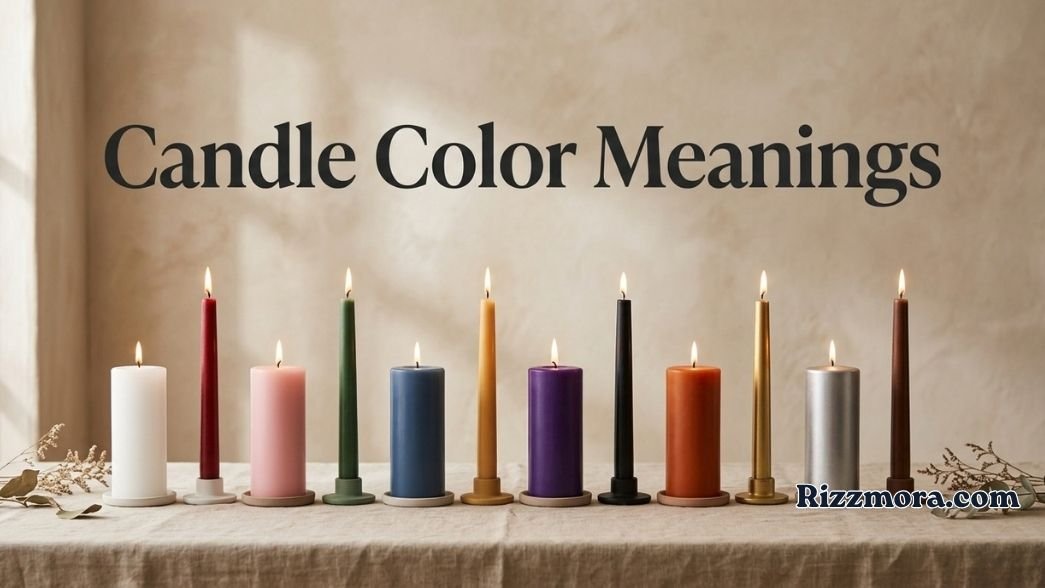
Have you ever wondered what different candles symbolize when you see a white candle creating a peaceful atmosphere, a red candle setting a romantic mood, or a green candle representing a fresh start? Understanding candle color meanings can help you choose the right candle for your home, meditation routine, spiritual practice, or special occasion.
Each color carries associations shaped by culture, history, personal experience, and modern candle practices. Whether you’re decorating your living space, setting a personal intention, or exploring spiritual traditions, knowing what different candle colors represent can make your choice more meaningful.
Interest in candle symbolism continues to grow as people look for simple ways to make everyday routines feel more thoughtful. Social media has also introduced more people to intention-setting, manifestation rituals, mindfulness, and color symbolism. Still, candle colors don’t have one universal meaning. A color that represents mourning in one culture may suggest celebration or renewal in another.
The good news? You don’t need to follow complicated rules to choose the right candle. Understanding common associations is enough to get started.
This guide explains what different candle colors symbolize, how to select a color for your goal, and how to use candles thoughtfully and safely.
Quick Answer: What Do Candle Colors Mean?
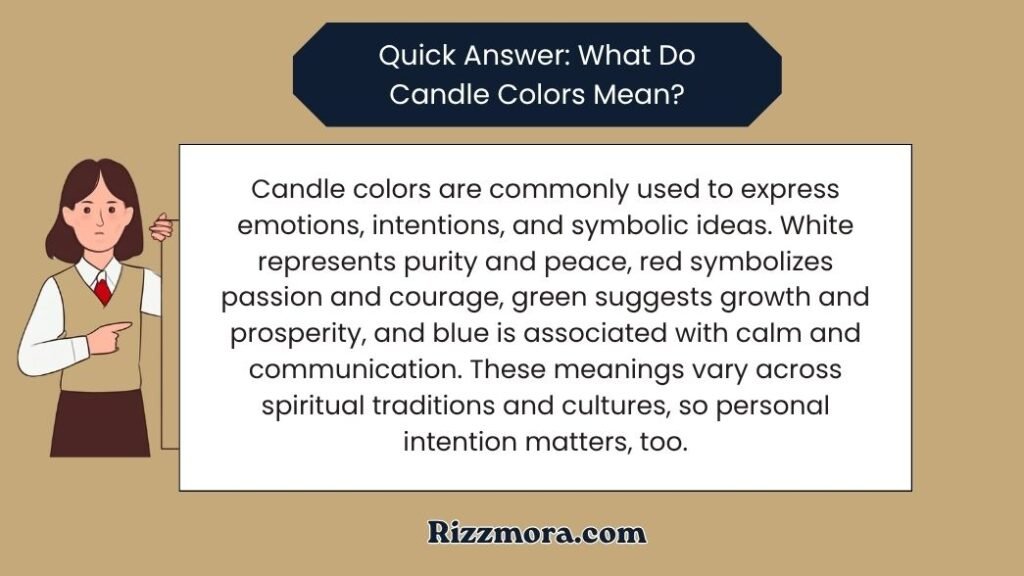
Candle colors are commonly used to express emotions, intentions, and symbolic ideas. White represents purity and peace, red symbolizes passion and courage, green suggests growth and prosperity, and blue is associated with calm and communication. These meanings vary across spiritual traditions and cultures, so personal intention matters, too.
- Example 1: A white candle can represent a fresh start or a peaceful atmosphere.
- Example 2: A green candle can symbolize financial goals, growth, or a new opportunity.
In short, choose a candle color that reflects the feeling or intention you want to emphasize.
Detailed Meaning Breakdown
Primary Meaning
The primary meaning of a candle color is the idea people commonly associate with it. These associations can guide decorating choices, meditation practices, personal rituals, and meaningful gifts.
For example, white candles often suggest simplicity, peace, or clarity. Red candles are commonly linked to love, desire, energy, and bravery. Green candles frequently represent nature, renewal, abundance, and financial growth.
These associations aren’t scientific rules. They’re symbolic shortcuts that help people express ideas without words. A candle’s color can make an intention feel more concrete, especially when it’s part of a regular routine.
Secondary Meanings
Colors can carry several meanings at once. Their interpretation often depends on the setting and the person using the candle.
Purple, for instance, may symbolize wisdom, creativity, intuition, or spiritual reflection. Yellow can suggest optimism, learning, confidence, or mental clarity. Black may represent protection, boundaries, endings, or the release of unwanted habits in certain spiritual practices.
This variety explains why there isn’t a single official dictionary of candle symbolism. The same color may serve different purposes in different traditions.
Rare or Misinterpreted Meanings
Some candle colors are misunderstood because people assume every tradition follows the same system.
Black candles aren’t automatically negative, and white candles aren’t always associated with celebration. In some cultures, white is used in mourning ceremonies. Likewise, red can symbolize love in one context and danger or warning in another.
Gold and silver also have overlapping interpretations. Gold commonly suggests success, achievement, or abundance, while silver may be associated with reflection, intuition, or lunar symbolism.
A useful rule is to consider the cultural setting, the ritual’s purpose, and your own associations before deciding what a color represents.
Also Read This: Pride Flag Meanings
What Candle Colors Mean in Different Contexts
In Spiritual Practices
In some spiritual and folk-magic traditions, candles are selected according to the intention behind a ritual. This practice is often called color correspondence.
White may be chosen for peace or spiritual clarity, green for abundance, blue for tranquility, and red for passion or courage. Purple is sometimes used for intuition or spiritual development.
People may combine candle lighting with prayer, meditation, journaling, or quiet reflection. The candle serves as a symbolic focus rather than a guarantee that a particular result will occur.
Practices differ widely, so it’s best to learn the conventions of a specific tradition instead of treating all spiritual systems as interchangeable.
In Home Decor
Color symbolism also influences interior design. Here, the goal is usually to create a particular atmosphere rather than perform a spiritual ritual.
White and cream candles fit minimalist spaces and make rooms feel visually lighter. Blue candles can complement a bedroom or reading corner, while green works well with natural materials and plants. Warm red, burgundy, and gold candles can add richness to a dining room.
I’ve found that candle color often works best when it supports the room’s existing palette rather than competing with it.
In Meditation and Mindfulness
During meditation, the color of a candle can act as a visual reminder of your chosen focus.
A blue candle might remind you to slow down and breathe. Yellow may represent optimism, while white can stand for simplicity or a mental reset. Green can serve as a reminder to make space for growth and balance.
You don’t need to believe in supernatural effects to use color this way. Associating a visual cue with a repeated habit can help make that routine more meaningful.
In Gifts and Special Occasions
Candle colors can communicate a thoughtful message without requiring a long explanation.
Pink candles make fitting gifts for friendship, affection, or self-care. White is a versatile choice for housewarmings and new beginnings. Gold can suit graduations, promotions, or milestone celebrations, while red may work well for romantic occasions.
For birthdays, weddings, and cultural ceremonies, consider the recipient’s preferences and traditions. A little context makes a symbolic gift more personal and helps you avoid an unintended message.
In Cultural Traditions
Color meanings are not universal. Religious practices, regional customs, family traditions, and historical experiences all influence how people interpret candles.
White, for example, may represent mourning in some East Asian traditions, while many Western settings associate white with weddings, cleanliness, or peace. Red can be associated with prosperity and celebration in Chinese cultural contexts, although its meaning depends on the occasion.
When a candle is intended for a religious or cultural ceremony, follow the customs of that community. General symbolism is a starting point, not a substitute for cultural understanding.
Where Different Candle Colors Are Used
- White: Used for prayer, reflection, peaceful decor, and symbolic fresh starts. A white candle can create a calm focal point on a meditation shelf.
- Red: Used for romantic settings, celebrations, and rituals focused on passion or courage. A red candle can add warmth to a dinner table.
- Pink: Used to represent affection, friendship, kindness, and self-love. A pink candle can make a thoughtful addition to a care package.
- Green: Used for themes of nature, renewal, growth, and prosperity. A green candle can complement a plant-filled workspace.
- Blue: Used to symbolize calm, patience, peace, and communication. A blue candle can suit a quiet reading nook.
- Yellow: Used for optimism, creativity, confidence, and learning. A yellow candle can brighten a study area.
- Purple: Used for wisdom, intuition, reflection, and spiritual exploration. A purple candle can mark a dedicated journaling space.
- Black: Used in some traditions for protection, boundaries, endings, or letting go. A black candle can also create a dramatic decor accent.
- Orange: Used to symbolize enthusiasm, creativity, motivation, and opportunity. An orange candle can add energy to a creative corner.
- Gold: Used for achievement, recognition, success, and abundance. A gold candle can make a celebration feel special.
- Silver: Used for reflection, intuition, and lunar themes in some symbolic systems. A silver candle can complement an evening meditation setup.
- Brown: Used to represent stability, practicality, grounding, and connection to the earth. A brown candle works naturally with rustic decor.
The setting matters as much as the shade. A decorative candle may simply match your furniture, while a ritual candle may represent a specific intention. Either approach is perfectly reasonable.
Spiritual, Numerology, or Cultural Meaning
Candle colors have a genuine connection to spiritual symbolism, although their meanings differ between traditions. Some people use them during prayer, intention-setting, seasonal observances, or personal ceremonies.
Color Symbolism in Intention-Setting
In modern spiritual practices, a candle can represent a goal you want to remember. A green candle might symbolize working toward financial stability, while a blue candle could represent a commitment to calmer communication.
The act of lighting the candle creates a repeated moment to reflect on that intention. It doesn’t guarantee a financial gain, relationship change, or other external result.
Candle Colors and Numerology
Some practitioners combine candle colors with numerology, assigning meaning to particular numbers, dates, or cycles. However, there is no universal numerological system for candle colors.
If you encounter a ritual that assigns a particular color to a number, treat that association as part of the specific practice rather than a rule shared by every tradition.
Cultural Meaning and Respect
Color symbolism can carry deep cultural significance. Red may feature in celebrations associated with luck and prosperity, while white may have ceremonial uses related to mourning, purity, or spiritual devotion.
Before adopting a ceremonial practice from another culture, learn its context and whether the practice has specific religious or community boundaries. Symbolism becomes more meaningful when it’s approached with respect.
Tone, Psychology, and Why People Choose Candle Colors
Why People Use Color Symbolism
People often choose a candle because its color gives a visible form to an idea. Someone starting a new job might select green to represent growth, while another person might prefer white because it feels clean and uncomplicated.
Color can also make routines easier to remember. If you always use the same candle during evening journaling, its appearance can become a familiar cue to pause and reflect.
These benefits are personal and practical. Although color psychology explores how colors may influence perception and emotion, responses vary by individual and context. Candle colors don’t reliably control another person’s feelings or guarantee a particular outcome.
The Emotional Layer Behind Each Color
Colors can suggest different moods, but the associations are flexible.
- Warm colors: Red and orange often feel energetic, expressive, or attention-grabbing.
- Cool colors: Blue and some shades of green may feel restful, balanced, or refreshing.
- Light colors: White, cream, and pale pink can suggest simplicity, gentleness, or openness.
- Deep colors: Burgundy, dark purple, and black may feel dramatic, reflective, or formal.
- Metallic colors: Gold and silver can suggest celebration, elegance, or special occasions.
Imagine choosing between a bright orange candle and a pale blue one for a reading room. The orange might feel lively, while the blue may better suit a quiet atmosphere. Neither is inherently better; the right choice depends on the mood you want.
Your memories matter, too. A yellow candle might remind one person of a happy summer, while someone else may associate it with caution. Personal experience can be just as influential as traditional symbolism.
10 Real Examples of Choosing Candle Colors
These examples show how the same color can communicate different intentions depending on the situation.
Example 1: Creating a Peaceful Evening
Situation: You light a white candle before spending a quiet evening alone.
Intended meaning: You associate white with simplicity, peace, and a fresh start.
Emotional tone: Calm and reflective.
Likely interpretation: The candle marks time for rest rather than signaling a specific spiritual belief.
Example 2: Celebrating a Relationship
Situation: You place two red candles on the table for an anniversary dinner.
Intended meaning: Red represents passion, romance, and affection.
Emotional tone: Warm and intimate.
Likely interpretation: Your partner may see the candles as a romantic decorative choice, even without knowing their symbolic meaning.
Example 3: Setting a Financial Goal
Situation: You light a green candle while reviewing your monthly savings plan.
Intended meaning: Green represents growth, prosperity, and financial progress.
Emotional tone: Hopeful and focused.
Likely interpretation: The candle acts as a reminder of your savings goal. It doesn’t directly create wealth or change financial outcomes.
Example 4: Preparing for an Important Conversation
Situation: You choose a blue candle before journaling about a difficult discussion.
Intended meaning: Blue symbolizes calmness, patience, and clear communication.
Emotional tone: Thoughtful and steady.
Likely interpretation: The color reinforces your intention to listen carefully and express yourself respectfully.
Example 5: Starting a Creative Project
Situation: You place an orange candle beside your sketchbook.
Intended meaning: Orange represents enthusiasm, creativity, and motivation.
Emotional tone: Energetic and optimistic.
Likely interpretation: It helps create a workspace that feels inviting and connected to your creative goals.
Example 6: Practicing Self-Care
Situation: You light a pink candle while enjoying a bath or reading a favorite book.
Intended meaning: Pink symbolizes kindness, affection, and self-love.
Emotional tone: Gentle and comforting.
Likely interpretation: The candle makes an ordinary self-care routine feel more deliberate and personal.
Example 7: Marking an Achievement
Situation: You use a gold candle during a small celebration after completing a challenging course.
Intended meaning: Gold represents achievement, recognition, and success.
Emotional tone: Proud and celebratory.
Likely interpretation: The color highlights a milestone and gives the occasion a festive touch.
Example 8: Reflecting on Personal Change
Situation: You choose a black candle while journaling about habits you’d like to leave behind.
Intended meaning: In some spiritual practices, black symbolizes endings, protection, or releasing unwanted patterns.
Emotional tone: Serious and introspective.
Likely interpretation: You’re using the candle as a symbol of change, not necessarily as an expression of negativity.
Example 9: Studying for an Exam
Situation: You place a yellow candle near your desk before reviewing your notes.
Intended meaning: Yellow represents optimism, learning, and mental alertness.
Emotional tone: Bright and encouraging.
Likely interpretation: The candle adds a personal touch to your study routine. It doesn’t replace sleep, preparation, or effective study methods.
Example 10: Reflecting on Spiritual Questions
Situation: You light a purple candle during a quiet meditation session.
Intended meaning: Purple is associated in some traditions with wisdom, intuition, and spiritual reflection.
Emotional tone: Contemplative and inward-looking.
Likely interpretation: The color helps establish a reflective atmosphere without requiring a particular religious belief.
Where Candle Color Meanings Are Commonly Misunderstood
Context Confusion
A color doesn’t carry one fixed message in every setting. Red may communicate romance in a bedroom, celebration at a party, or warning on a safety label.
Likewise, black candles may appear in spiritual rituals, elegant home decor, or seasonal displays. Assuming that a candle reveals someone’s intentions without asking can lead to unnecessary confusion.
Consider the setting before interpreting the symbolism. A candle chosen to match a room may have no deeper meaning at all.
Generational Gap
People of different ages may associate colors with different memories, trends, and cultural references.
A younger adult who discovers manifestation practices through social media might view a green candle as a symbol of abundance. An older family member might simply see it as a seasonal decoration.
Neither interpretation is automatically wrong. Asking about the person’s intention is more useful than assuming everyone shares the same symbolic vocabulary.
Platform Differences
Social media can make traditional symbolism appear more uniform than it really is. A short video may present a single meaning for every candle color, leaving out historical, religious, and regional differences.
A creator might also use a color for aesthetic reasons rather than spiritual ones. When exploring online candle rituals, distinguish personal interpretations from established traditions, and be cautious of claims that a candle guarantees love, money, or protection.
Similar Symbols and Color Associations
The following terms often appear alongside candle symbolism, but they refer to different ideas or practices.
| Term | Meaning | How It Differs from Candle Colors |
|---|---|---|
| Color psychology | Study of how colors relate to perception and behavior | Examines responses to color rather than assigning ritual intentions |
| Color correspondence | Association between a color and a symbolic purpose | Provides a framework for selecting ritual candles |
| Intention-setting | Choosing a goal or quality to focus on | Centers on personal purpose, not a particular color |
| Manifestation | Practice of focusing on desired outcomes, often through visualization or intention | May incorporate candles but doesn’t require them |
| Meditation | Practice involving attention, awareness, or reflection | Can use candles as optional visual focal points |
| Aromatherapy | Use of aromatic substances for sensory or well-being purposes | Focuses on scent rather than color symbolism |
| Candle magic | A practice in some spiritual and folk-magic traditions using candles symbolically or ritually | May combine color, intention, timing, and other ritual elements |
| Feng shui | Chinese tradition concerned with spatial arrangement and environmental harmony | Uses broader principles of space and symbolic associations, not just candle color |
| Chakra symbolism | System associating energy centers with particular colors in some Indian-derived spiritual traditions | Uses color within a specific framework rather than a universal candle-color dictionary |
| Seasonal symbolism | Meanings connected with seasons, festivals, and natural cycles | Explains why certain candle colors suit particular celebrations |
These ideas sometimes overlap, but they aren’t interchangeable. Understanding the difference helps you choose a practice that fits your interests instead of mixing unrelated traditions without context.
When Not to Rely on Candle Color Meanings
Professional Risks
Candle symbolism is best kept separate from workplace decisions that require evidence. A green candle may represent growth to you, but it shouldn’t influence an investment decision, hiring choice, or business forecast.
Similarly, avoid assuming that a colleague’s decorative choices reveal their personality, beliefs, or intentions. Professional communication works best when people rely on clear language and observable behavior.
Cultural Risks
Some candle colors have specific meanings in religious ceremonies, memorials, and cultural celebrations. Using them without understanding their context can unintentionally communicate something different from what you intended.
If you’re attending a ceremony or giving a candle as a gift, check whether the color has a particular significance. A small amount of research or a respectful question can prevent an awkward situation.
Tone Risks
Dark colors aren’t automatically negative, and bright colors aren’t always cheerful. A person may choose black because it suits their decor, not because they’re experiencing difficulty.
Avoid using symbolism to judge someone’s emotional state. If you’re concerned about a friend, a sincere conversation is more reliable than interpreting the color of a candle on their shelf.
Expert Tips for Choosing Candle Colors
Use these practical tips to make thoughtful choices without getting caught up in rigid rules.
- Start with your goal. Decide whether you’re creating a relaxing room, celebrating a milestone, or marking a personal intention.
- Learn the common associations. White often suggests peace, green suggests growth, and blue is linked to calmness.
- Consider your personal response. Choose a color that feels meaningful to you, even if your association differs from a traditional one.
- Check the cultural context. If the candle is intended for a ceremony, learn the customs that apply.
- Match the room when decorating. Think about wall colors, lighting, furniture, and the atmosphere you want.
- Keep spiritual expectations realistic. A candle can support reflection, but its color doesn’t guarantee a particular result.
- Use one clear intention. A simple focus, such as patience or creativity, can make a personal ritual easier to follow.
- Avoid judging other people. Never assume that someone’s candle color reveals their beliefs or emotional state.
- Prioritize fire safety. Place candles on stable, heat-resistant surfaces, keep them away from flammable materials, and never leave a burning candle unattended.
- Choose a flameless alternative when needed. Battery-operated candles can provide a similar visual effect in settings where an open flame isn’t appropriate.
The best choice isn’t necessarily the color with the most elaborate symbolic explanation. It’s the one that suits your purpose, respects the setting, and makes sense to you.
Frequently Asked Questions
1. What do candle colors mean?
Candle colors represent different ideas, emotions, or intentions in decorating and spiritual practices. White commonly symbolizes peace, red suggests passion, green represents growth, and blue is associated with calmness. These are common interpretations rather than universal rules, so context and personal preference should guide your choice.
2. Which candle color is best for positive energy?
Yellow, orange, and white are popular choices for symbolism associated with optimism, enthusiasm, and peace. Green may also represent renewal and growth. No color has been proven to generate supernatural energy, but selecting a shade that feels uplifting can make a room or personal routine more inviting.
3. What candle color represents love?
Red is widely associated with romantic passion, while pink often symbolizes affection, tenderness, friendship, and self-love. Either can suit a romantic evening or a thoughtful gift. The distinction isn’t strict: choose red for a bold atmosphere or pink for a softer expression of care.
4. What does a black candle symbolize?
Black candles can represent protection, boundaries, endings, or the release of unwanted habits in certain spiritual traditions. They are also used in modern interior design because of their dramatic appearance. A black candle isn’t automatically associated with bad luck or negative intentions; its meaning depends on the person and context.
5. Which candle color is used for money and prosperity?
Green is a common symbol of financial growth, abundance, and new opportunities. Gold is also associated with success, achievement, and prosperity. Some practitioners incorporate these colors into intention-setting rituals. Lighting a candle, however, doesn’t guarantee wealth, so pair symbolic practices with practical financial planning.
6. Can candle colors have different meanings in different cultures?
Yes. Color symbolism varies across regions, religions, and traditions. White, for instance, can represent purity or peace in some settings and mourning in others. Red may be associated with celebration and prosperity in certain Chinese cultural contexts. When choosing candles for ceremonies, follow the relevant community’s customs.
7. How do I choose the right candle color for meditation?
Start by deciding what you want your meditation session to emphasize. White can represent simplicity, blue may suggest calmness, green can symbolize balance or growth, and purple may suit spiritual reflection. You can also choose a favorite color simply because it helps you feel comfortable and focused.
8. Is there a scientifically proven meaning for each candle color?
No. There is no universally validated scientific system assigning a fixed meaning or outcome to every candle color. Research into color psychology explores how color can influence perception and associations, but responses depend on context and individual experience. Candle symbolism is best understood as cultural, personal, or spiritual interpretation.
Final Summary and Smart Usage Advice
Understanding candle color symbolism can help you make more thoughtful choices for your home, meditation routine, celebrations, and personal rituals. The main idea is simple: colors offer a symbolic way to express feelings and intentions, but their meanings aren’t universal.
White is commonly associated with peace and clarity. Red represents passion and courage, while pink suggests affection and kindness. Green is linked to growth and prosperity, blue to calmness and communication, and yellow to optimism and learning. Purple can symbolize wisdom or spiritual reflection, while black may represent boundaries or endings in certain traditions.
These associations are useful starting points, not strict rules. Your culture, personal experiences, and the setting all influence how you interpret a particular shade. A candle chosen for its appearance doesn’t need a spiritual explanation, and a candle used in a ritual doesn’t guarantee the outcome you hope for.
For everyday use, begin with your purpose. Think about the mood you want, the tradition you’re following, or the message you want a gift to communicate. Then choose a color that supports that intention without overcomplicating the decision.
Remember to consider cultural differences, avoid judging other people by their choices, and follow basic fire-safety precautions whenever you burn a candle.
You now have a practical foundation for understanding candle symbolism and selecting colors with confidence.
The simplest rule to remember: choose the color that reflects your intention, respect its context, and let the meaning be personal rather than absolute.

Hi, I’m John Anderson, an author at RizzMora with years of experience exploring texting slang, internet abbreviations, and everyday online language. I enjoy making confusing terms simple and easy to understand.
One thought on “Candle Color Meanings? A Complete Guide to Their Symbolism and Uses (2026 Guide)”